Sunday, 4 October 2009

Sod's Law: getting red without knowing how or the lament of the toss it in and see what happens dyer

I am always on the hunt for reds. Madder red is often elusive as I have very soft water, brazilwood goes a not very nice purple when felted and is not very light fast so that leaves cochineal.
Last week sometime I decided to do some cochineal dyeing. I tossed in some ground cochineal-how much? I can't remember-I think 50 g but I am not sure. I added some cream of tartar. How much? Possibly a tablespoon and then soaked the cochineal for how long? Possibly two days which was then heated in the electric casserole till it simmered (I think). When it cooled I tossed in 100g of merino mordanted with 12% alum 5% cream of tartar and left it -for how long?I don't know. I heated (I think till it simmered) but for how long I don't know. :(
Here is the result.
Yummy yummy crimson (it does not come out so well on the screen -another sod's law.
I will never be able to get this again. :(
Sold it all yesterday :( and :)
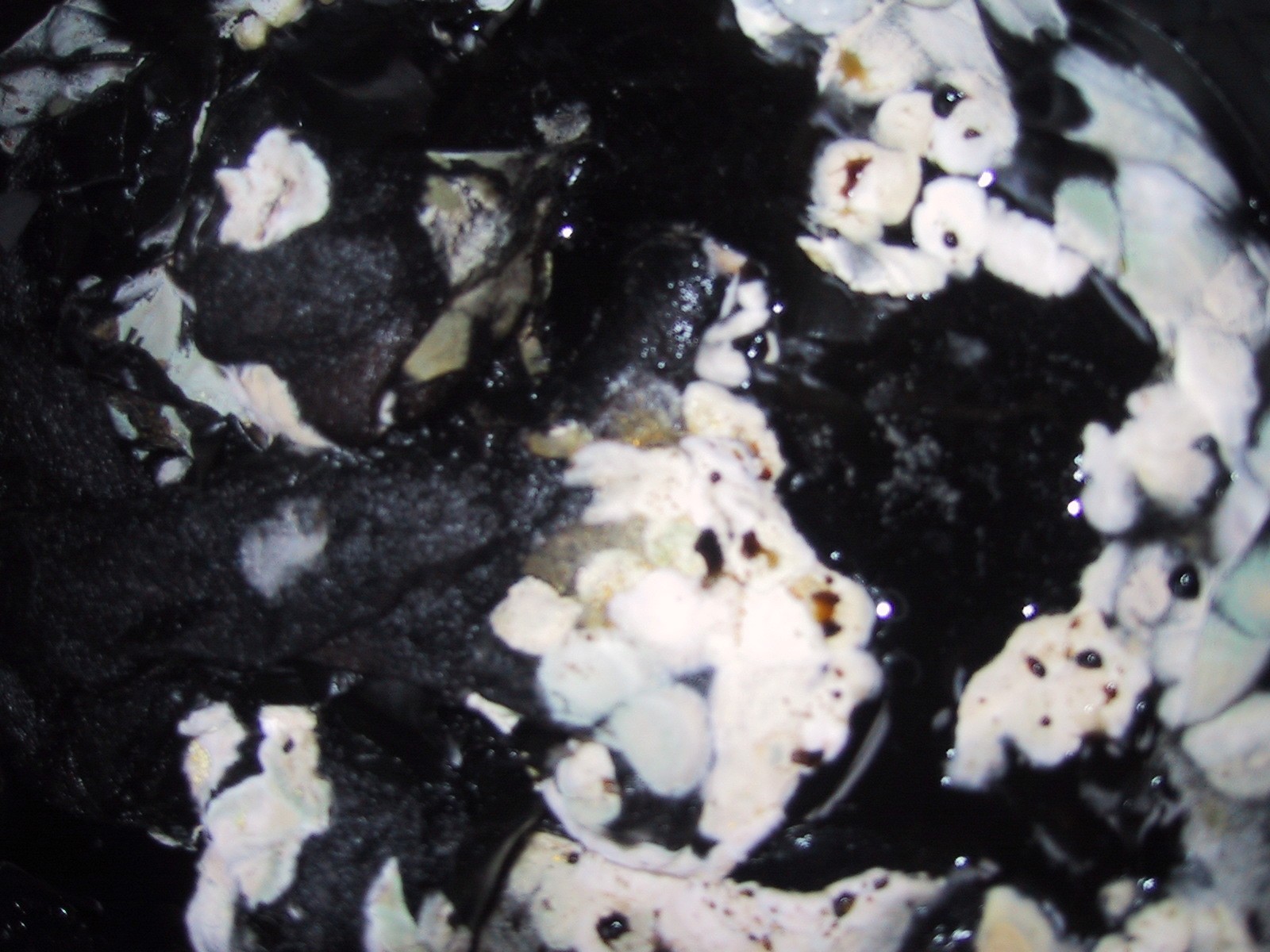
The exhausts are very pretty too

Welcome to all the new followers -nice to have you

Saturday, 26 September 2009

Fermented Indigo Vat


I have had a fermented indigo vat on the go now for over a month. I set it up for a Dyeing the Blues workshop in my studio at the end of August and it has been going ever since and students at my most recent Dyeing the Blues on the 24th of September were able use it. My visitors coming to visit over the past two weekends of the Helfa Gelf Open Art Studio event have been intrigued by it and a few have braved the label of "rather smelly" and asked for a demo. One male visitor who was studying, he told me, for a diploma in archaeology, lifted the lid to have a sniff presumably to get an authentic whiff of the past! I tell people that dyeing with indigotin (the proper name for the indigo blues ) is ancient, widespread and that for thousands of years this is how people have got blue and they are mostly fascinated.

This particular vat has been superb. It is a madder bran vat using woad ash lye-a 17th century recipe I originally got from Sandberg*. wood ash lye is easily made by filling a bucket with wood ash and topping up with water. After a couple of the weeks the clear water at he tops is a mixture of potassium carbonate and potassium hydroxide . During my reading for research for my indigo book (The Colour of the Sea and Sky, The Art of Indigo Dyeing) I found references to different types of woodash. It was said that woodash from oak made the best lye for fermentation vats and after that hardwoods. A local woodworker working in oak burnt all his scraps for me and made an oak ash from which I made a lye.This vat is made from that and whether for that reason or not has been superb.

The vat sits on a hotplate originally used for wine making which keeps the vat warm at between 35-to 40-degrees. Fermentation vats do like to be kept warm. The madder and the bran ferment and as they do so they use up all the oxygen in the water. At the start the wood ash lye made the vat alkaline with a pH of about 10. As fermentation proceeds it creates lactic acid and this makes the pH drop so every morning I stir the vat, check the pH adding washing soda if it has dropped . When the vat has no oxygen in and is alkaline the insoluble indigotin converts to its soluble form when it will bond to the fibres. Removing the fibres from the vat results in the oxygen in the air converting the soluble form back into the insoluble indigotin which is bonded to the fibres.

Every now and again ( such as once a week) I drop in an handful of madder and of bran and three times in the last month 10g of indigotin mixed with hot water to a paste.

The million dollar question is -why do I like the fermentation vat so much? The answer is it is so easy to use. You just put something and leave it -overnight more often then not. Oxidise and then put it back for a couple of hours for the deeper blues and you can see from the photo how dark some of my blues are. These are much more difficult to get with the modern chemical vat which has to be carefully balanced to make sure that indigotin is not stripped off as a fast as it is deposited. I also like the sense of being connected to thousands of years of history

Madder and Bran Vat

This vat has the advantage of being least smelly of the fermented vats and comes from a seventeenth century recipe. You will need:

  • 9 litres water

  • 60g madder

  • 20g bran

  • 22g indigo made to a paste

  • 500ml of wood ash lye

Put water, madder, and bran in a pan, with the wood ash lye and heat to boiling. Boil for 15 minutes. The scum on the surface will turn pink then a rather gorgeous purple. Allow to cool to 40°C and then add the indigo paste. Maintain this temperature and stir daily.

At 40 degrees C this vat will come into order within two days but the pH will drop rapidly. Add a tablespoon of washing soda on the second day or if you see that fermentation is rapid with lots of little bubbles on the surface, and stir well. As it comes into order you will see a patina of indigo on the surface like a coppery blue sheen. The characteristic slightly murky green liquid underneath may be slightly masked by colour from the madder but experiment by dipping some fibres leave for half an hour and remove. You should then see the yellowy green colour on the fibres.


J.N. Liles The Art and Craft of Natural Dyeing: Traditional Recipes for Modern Use University of Tennessee Press ISBN 0-87049-0

Gosta Sandberg Indigo Textiles Technique and History Lark Books ISB9372274


You are most welcome to use this information on this blog for your own personal use but it is copyright Helen Melvin and the information is not to be used for commercial gain.

Ps I am still carrying on with some shibori (see previous post)

Tuesday, 15 September 2009

Shibori & Felt

The Online Guild of Weavers Spinners and Dyers are running a shibori workshop. The tutor is Rachel Hardy and the workshop exemplifies, I think, how good an Internet group like this is as we can all use what ever we want to and do it in our own pace. Rachel has a very free and easy experimental approach which I like and some fabulous pieces. She talks about the techniques and we use what fabric and dyes we wish. Rachel dyes with procion dyes on cottons as she makes quilts. I am using natural dye extracts and fine felt. Sadly for us ( and for Rachel) she has been laid low with a malevolent dose of 'flu and we are all hoping she will recover soon. So far we are only looking at folding clamping tying but there is enough in these techniques alone to keep us very busy. Originally I intended to use what ever I had -bits and pieces of fabrics and silks, but a few years ago I did some stitched shibori on fine felt and have wanted to do more of it ever since so I have succumbed to using felt -whatt a surprise- and now I have to make my fabric before I start dyeing with it. This takes time so I have only a few pieces. One of the stoles I took to summer school, which I sold too, was tied around 2p pieces and I loved the effect.

The top picture is tied around two p pieces with a thick hessian thread and dyed in jazz -an Earthues logwood-and annatto. The picture below is the other side

This piece above was wrapped around a piece of dowelling , tied with linen thread, and dipped many times into a fermented indigo vat. I then united, retied and dipped again
This piece above was tied with fine linen threads and dyed in annatto,jazz and green extracts being retied every time. below is the other side.


This piece above was dyed in indigo after tying around a spaghetti jar with thick hessian thread which was then pushed down till the felt was very crumpled.The above piece was part of the demo I did while giving a talk to the Abergele Guild of WSD ( you can see more of that here) was folded in half, rolled around a piece of dowelling , tied with linen thread, and then using pipettes, I dropped annatto, lac and brazilwood onto the felt.


So above are my first samples. All are on 18.5 micron merino except the last two which are on fine pieces of 16 micron merino.

Sunday, 6 September 2009

Helfa Gelf Open Studio Event

I am open!

Come and Visit Me !
The Dye Garden
See My Pictures
Watch Demonstrations
Browse Through My Shop


Dates?
September
Friday Saturday Sunday
11th
12th
13th

Friday 18th with LATE NIGHT OPENING 7-9
Saturday 19th
Sunday 20th

Friday 25th
Saturday 26th
Sunday 27th
Times?
11am-5pm


What's On
Demonstrations
First weekend
11th-13th
Making a fine stole using 17. 5 Micron Merino
Indigo dyeing & fermentation vats
Natural Dyes

Where?
Find me just off the B5429 in Aberwheeler Just opposite the side of the white railings of the Chapel the Waen Aberwheeler 1/4 mile from the turning off the A541 Mold DenbighSt Asaph road at Bodfari.

I am 20 minutes from the Caerwys exit on the A55-take the road through Caerwys, down the hill turn right onto the A541 , go through Bodfari Village and turn left onto the B5429 and follow directions as above
I am just 20minutes from the St Asaph exit off the A55. Follow the signs for St Asaph then for Denbigh but turn right at Trefnant Traffic lights onto the A541 and then turn right onto the B5429 just before you enter Bodfari Village oppposite Gienas Farm
Find out More and see where you can go at
Helfa gelf/art Trail 2009

Wednesday, 26 August 2009

A Busy August- Fine Felt Stoles

Jackie Jo and Dianne wearing their stoles on Gala night
Sally and Barbara wearing their stoles on Gala Night

I can't believe how long it has been since I blogged!

Since the last post I have taught at the Association of Weavers Spinners and Dyers Summers School at Lincoln. This was a fantastic experience. The students on the course started with 18.5 micron white merino, silk fibres and fabrics and dyed them with extracts of natural dyes in the first day and half,then started exploring how to make fine felt, a half day learning in different ways to make felt and fabric brooches. Then started making a fine stole- a formidable undertaking that took them twelve hours of very hard work. Felting with two fine layers of this fine merino sandwiched between two fine pieces of plastic sheeting to start with is an amazing experience as the fibres transform from two layers of wool to a piece of fabric with a fine fold and drape. The students worked hard starting on the felting days at 8am and some went onto to 10pm.

What has been such an exciting experience for me was that as all the students knew about natural dyeing and had in all cases done some felting and in most cases done a lot it turned into a master class and that was a quite fantastic experience for me to teach especially so as all had good design skills too and colour sense so you will not be surprised to hear that the resulting stoles were quite outstanding. as indeed you can see- we all wore them on the last gala night
Classroom


Classroom from the other end
Fibres dyed with extract dyes hanging up to dry
The first of two layers being put down


Two layers ready tobe wetted out.


On the last day students put up an exhibition of their work samples and finished pieces
EvelynGillAnthea
Jill

Dianne
Barb
Amanda
Ann
Ineke
Jo
Carole
Myra
All of the students.
Welcme to the new followers-how I wish some of would stop by and say hello.

Friday, 31 July 2009

Instant dyeing the natural way

Top Row Persicaria Tinctoria top left
Bottom Row Golden rod flowers first left, flowers with ammonia, stems and leaves, stems and leaves with ammonia
Top Row Centre Golden Rod flowers over dyed with Persicaria Tinctoria and on right golden rod leaves and stems overdyed with Persicaria Tinctoria


Posted by Helen
Written on the 31st of July

I am busy getting ready to teach for a week at the Association of Weavers Spinners and Dyers Summer School-which event I have been getting ready for for weeks if not months. But yesterday I loaded the car and today pottered around doing bits and pieces and Enys came round to garden. The garden is reproaching me, full of dye that is not being used. I have dried armfuls of weld,Gensita Tinctoria and yarrow. But the Persicaria is going blue at the edges showing it is ready for dyeing and the golden rod in flower. SO................
100g of damp ( because we had had a lot of rain) golden rod flowers into one slow cooker, 100g of golden rod leaves and stalk into another. Topped up with 4 litres of water. About 100g of damp mordanted (8%Alum 7%Cream of tartar) Wensleydale added.
Both on "Keep warm" facility -this is about 80 degrees.
one hour later the flowers had dyed the Wensleydale a bright clear yellow while the stalks and leaves showed no colour at all
The tops of three Persicaria T plants were chopped off leaves stripped and ripped up into a pan covered with cold water put onto the gas stove in the kitchen as my electric rings are packed. Heated till hand hot. Left to sit for about half an hour while Enys weeded the over grown veg garden because I think she despaired of me ever doing it . I squeezed out the leaves, added 1 tablespoon of washing soda so the water went from a sherry colour with a blue tinge to a dark green. I started to beat the water with a whisk and the water went turquoise. I added 1 teaspoon of thiourea dioxide-this is quite a lot but I always reckon that the water is full of oxygen after all the whisking to precipitate the indogotin and needs it. I had to heat the vat up again as it had gone cold but after another 20 minutes it had gone a clear greeny yellow and dyed 50g of merino 18.5micron a nice blue.

Within one hour of picking I had bright yellow, blue and green fibres. Not bad for a "slow" process. Not only was the colour pretty quick but it only took me a few minutes to prepare the dye baths.In both cases while Enys and I were having a cup of coffee,one at the start of her visit and one at the end!

Thursday, 30 July 2009

More on Weld

I have just been reminded that Jenny Dean wrote an excellent account of dyeing with weld in Anglo Saxon times on her blog. I am ashamed to have forgotten this -just to many things to think about I suppose but that is no excuse really. The importance of Jenny's contribution, aside from showing that Anglo Saxons were a colourful lot, is that you can get a good colour with weld without using alum. She used woodash lye as an post mordant. You can find her work here