Tuesday, 24 November 2009

Art Yarns or Extreme spinning! ( And the Textile market)

I have been having fun! Early on this year when I was recuperating from Pneumonia I came across Pluckyfluff's book Intertwined , full of wonderful textured yarns. A light bulb moment came "Idid not need to spin for a project-which I find boring- I could spin for fun!" and as the mood took me and use up some of my stash into the bargain. This November after the dreaded horrible asthma and huge doses of steroids etc etc I suddenly felt as though all the energy had drained out through the bottom of my legs and gone somewhere. On top of which we now have a wonderful cosy sitting room with fantastic wood burner.
So guess what? Some ( but only a tiny bit really ) of my stash mysteriously moved into corner of the sitting room My lovely lovely lendrum spinning wheel took up residence and I was away spinning textured and very textured yarns in the evening when I am too tired for anything else . At first I thought I would just spin but everybody ( well nearly everybody) was so enthusiastic about the resulting Yarns I decided to sell them. I had a few at the Real Colour Show where I sold some but here are the ones I have spun for my Next Event
The Textile Market at Trefriw Woollen mill 5th /6th December

This a wonderful event-last year it was called The Artisan Market and there were only three of us selling but this year it is much bigger with Me selling fibres ( new range Beyond the Pale- merino's,cashmere and silk, teeswater) Beyond the Twist Yarns, natural dye inks ,brooches books& kits. Debbie The Mulberry Dyer, with dyes, books, yarns tools, my friend Anne with brooches, scarf kits superb designer knitted scarves and more more more!
I will be putting the yarns on my website in the next few days.

Sunday, 15 November 2009

Fine Stoles in natural dyes


Sunday 15th
When I was at the Real Colour Show at Llanidloes in mid Wales a local shop l'Amoire, bought all my fine stoles of which I had three, a fine felt collar and a fine felt scarf.,This means I have now sold all I have made which is enormously satisfying. So now I am starting to make some more! These are being made using 17.5 micron Merino that one of my students at Lincoln Summer School told me about-and which I got from Adelaide Walker in Yorkshire. Thanks to Bettina of Woolly Bits I have also bought a kilo of 16 micron merino from Germany. These are all Merino's from South Africa and so not from sheep which have been muled. Yesterday I dyed my first 100g of this -worried that being so fine it might felt-but it seems to be okay. Today however I am going to make a stole in terracotta using cashmere and silk as the first layer and 17.5 micron merino on the top. I dyed the cashmere and silk yesterday using madder, cutch, osage orange, and cochineal extracts of natural dyes. This is now hanging from a chair in front of a wood burner drying out. It is a still a little damp.The 17.5 micron merino I dyed some while ago as I have a commission to make a stole in terracotta. The 16 micron will have to wait-it is drying and I don't want to hurry it and perhaps felt it!
Thursday 19th
The fine merino stole is still sitting wet and damp on my table waiting to be further felted. It won't come to harm like this but I had to put it on hold as I had a commission to dye fine merino and silks. A welcome bit on money in a quiet month. Yesterday I decided to try spinning again with Abergele Guild of Weavers Spinners and Dyers which meets at a lovely village in Llanfair TH on a wednesday afternoon. However we have had a lot of rain and as I drove and saw the flooded fields Ihad mny doubts about my wisdom in going. If you click on the link you will see what met my eyes as I came down the long hill into the village.
This is the 16micron dyed and ready to be felted

Monday, 9 November 2009

Harvest!


I haven't been blogging for a while- you may have noticed! There are lots of reasons some of which are being very busy and having severe asthma for six weeks but these are boring -the real reason is the combination of a brand new laptop and my springer spaniel. My springer spaniel, called Walnut because the brown of her coat is the colour of the dye given by walnuts, hates me being on the computer. Every time down I sit down at the computer desk she pats me commandingly with her paw which usually means "stop wasting time doing that and throw a ball" but sometimes means "feed me" but more usually just " I am a poor pathetic deprived and ignored dog give me some love ".

I love gizmo's, computer technology and all that and so have long hankered after a lap top consequently when I sold a picture while I was open for an open art studio event in Septmeber -Helfa Gelf definitely on next year- I brought a laptop. Hooray! One of the events I was also being busy over was the Real Colour Show, a ten day feast of natural colour, talks, workshops and lectures in mid Wales in October . It was a fantastic event-hopefully on next year- and as I had promised over six months ago to give a talk at it about how I paint with fibres via a laptop and digital projector, I had to get a laptop, work out how to use it, down load all the free share wear I use(thank you Leigh Tate who showed me how to do that) devise the talk, import pictures from my pc, work out how to do a digital presentation all in the first week of the event -hence not blogging about it -my original intention. I did my talk -to all of about 12 people which was a bit disappointing.However other demo's presentations and workshops were much better attended.


After all this I decided to take November off. Goody goody I thought I shall blog in bed first thing in the morning or last thing a night on my lovely new laptop. This is where the springer spaniel comes in. I start to blog- a nose appears then before I know what has happened a nose and a paw are laid on the lap top. That is why I have not been blogging.

We have been working hard on the dye garden or rather Enys son-in law, Jamie, has as he has a landscaping business. He has been clearing trees, trimming hedges and in the summer helped John put up a new summer house. (AKA The Man Shed) In the photos below you can see him and his brother demolishing a rather hideous raised bed and incidentally entertaining the dog who tends to think all this is being laid on for her benefit.

In the raised bed there is a madder plant visible in the foreground of the second photo. This is now three years old so after the wall had been demolished Jamie carefully picked out all the madder roots for me. All 2.8 kilo's of them. Some of the roots are 1/4 inch thick and are bright orange. If you break them and expose the orange root to the air they turn red.

The bed had a tendency to be a bit dry even in our wet climate and was overshadowed a bit by a large ash tree. Apart from the odd bit of organic chicken manure that is all the plant has had. However it was obviously very happy and healthy and rambled all over one half of the bed.The other half was full of golden rod which was not so keen on the drier conditions and flourished better in other parts of the garden


The new beds will be filled with dyers corepsis-it took my entire dried crop to make 8 bottles of a fabulous orange ink , and dye 200g of merino to a burnt orange, so I want more and persicaria tinctoria and chinese woad. I ran two dyeing the blues workshop in my studio last summer and could have run more if I had had more plants!

Welcome to the new followers- I do usually blog more than I have been recently and now things have quietened down a bit I shall be back to blogging form! The next thing is to dye with some of the madder and dry the rest and leave for a year. So hopefully next year I shall see whether it is worth drying madder. It is supposed to bring out the reds.


Sunday, 4 October 2009

Sod's Law: getting red without knowing how or the lament of the toss it in and see what happens dyer

I am always on the hunt for reds. Madder red is often elusive as I have very soft water, brazilwood goes a not very nice purple when felted and is not very light fast so that leaves cochineal.
Last week sometime I decided to do some cochineal dyeing. I tossed in some ground cochineal-how much? I can't remember-I think 50 g but I am not sure. I added some cream of tartar. How much? Possibly a tablespoon and then soaked the cochineal for how long? Possibly two days which was then heated in the electric casserole till it simmered (I think). When it cooled I tossed in 100g of merino mordanted with 12% alum 5% cream of tartar and left it -for how long?I don't know. I heated (I think till it simmered) but for how long I don't know. :(
Here is the result.
Yummy yummy crimson (it does not come out so well on the screen -another sod's law.
I will never be able to get this again. :(
Sold it all yesterday :( and :)
The exhausts are very pretty too

Welcome to all the new followers -nice to have you

Saturday, 26 September 2009

Fermented Indigo Vat


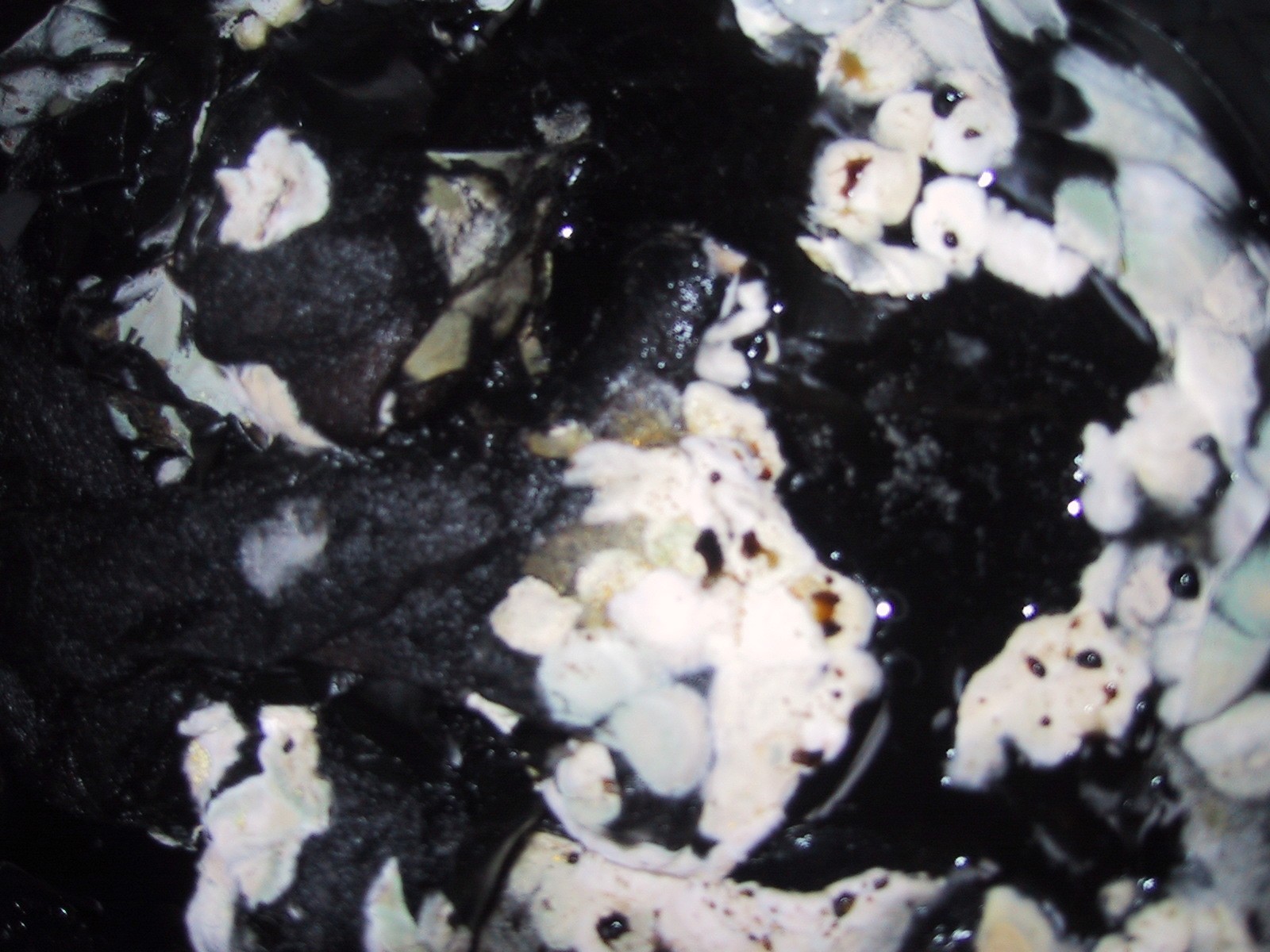
I have had a fermented indigo vat on the go now for over a month. I set it up for a Dyeing the Blues workshop in my studio at the end of August and it has been going ever since and students at my most recent Dyeing the Blues on the 24th of September were able use it. My visitors coming to visit over the past two weekends of the Helfa Gelf Open Art Studio event have been intrigued by it and a few have braved the label of "rather smelly" and asked for a demo. One male visitor who was studying, he told me, for a diploma in archaeology, lifted the lid to have a sniff presumably to get an authentic whiff of the past! I tell people that dyeing with indigotin (the proper name for the indigo blues ) is ancient, widespread and that for thousands of years this is how people have got blue and they are mostly fascinated.

This particular vat has been superb. It is a madder bran vat using woad ash lye-a 17th century recipe I originally got from Sandberg*. wood ash lye is easily made by filling a bucket with wood ash and topping up with water. After a couple of the weeks the clear water at he tops is a mixture of potassium carbonate and potassium hydroxide . During my reading for research for my indigo book (The Colour of the Sea and Sky, The Art of Indigo Dyeing) I found references to different types of woodash. It was said that woodash from oak made the best lye for fermentation vats and after that hardwoods. A local woodworker working in oak burnt all his scraps for me and made an oak ash from which I made a lye.This vat is made from that and whether for that reason or not has been superb.

The vat sits on a hotplate originally used for wine making which keeps the vat warm at between 35-to 40-degrees. Fermentation vats do like to be kept warm. The madder and the bran ferment and as they do so they use up all the oxygen in the water. At the start the wood ash lye made the vat alkaline with a pH of about 10. As fermentation proceeds it creates lactic acid and this makes the pH drop so every morning I stir the vat, check the pH adding washing soda if it has dropped . When the vat has no oxygen in and is alkaline the insoluble indigotin converts to its soluble form when it will bond to the fibres. Removing the fibres from the vat results in the oxygen in the air converting the soluble form back into the insoluble indigotin which is bonded to the fibres.

Every now and again ( such as once a week) I drop in an handful of madder and of bran and three times in the last month 10g of indigotin mixed with hot water to a paste.

The million dollar question is -why do I like the fermentation vat so much? The answer is it is so easy to use. You just put something and leave it -overnight more often then not. Oxidise and then put it back for a couple of hours for the deeper blues and you can see from the photo how dark some of my blues are. These are much more difficult to get with the modern chemical vat which has to be carefully balanced to make sure that indigotin is not stripped off as a fast as it is deposited. I also like the sense of being connected to thousands of years of history

Madder and Bran Vat

This vat has the advantage of being least smelly of the fermented vats and comes from a seventeenth century recipe. You will need:

  • 9 litres water

  • 60g madder

  • 20g bran

  • 22g indigo made to a paste

  • 500ml of wood ash lye

Put water, madder, and bran in a pan, with the wood ash lye and heat to boiling. Boil for 15 minutes. The scum on the surface will turn pink then a rather gorgeous purple. Allow to cool to 40°C and then add the indigo paste. Maintain this temperature and stir daily.

At 40 degrees C this vat will come into order within two days but the pH will drop rapidly. Add a tablespoon of washing soda on the second day or if you see that fermentation is rapid with lots of little bubbles on the surface, and stir well. As it comes into order you will see a patina of indigo on the surface like a coppery blue sheen. The characteristic slightly murky green liquid underneath may be slightly masked by colour from the madder but experiment by dipping some fibres leave for half an hour and remove. You should then see the yellowy green colour on the fibres.


J.N. Liles The Art and Craft of Natural Dyeing: Traditional Recipes for Modern Use University of Tennessee Press ISBN 0-87049-0

Gosta Sandberg Indigo Textiles Technique and History Lark Books ISB9372274


You are most welcome to use this information on this blog for your own personal use but it is copyright Helen Melvin and the information is not to be used for commercial gain.

Ps I am still carrying on with some shibori (see previous post)

Tuesday, 15 September 2009

Shibori & Felt

The Online Guild of Weavers Spinners and Dyers are running a shibori workshop. The tutor is Rachel Hardy and the workshop exemplifies, I think, how good an Internet group like this is as we can all use what ever we want to and do it in our own pace. Rachel has a very free and easy experimental approach which I like and some fabulous pieces. She talks about the techniques and we use what fabric and dyes we wish. Rachel dyes with procion dyes on cottons as she makes quilts. I am using natural dye extracts and fine felt. Sadly for us ( and for Rachel) she has been laid low with a malevolent dose of 'flu and we are all hoping she will recover soon. So far we are only looking at folding clamping tying but there is enough in these techniques alone to keep us very busy. Originally I intended to use what ever I had -bits and pieces of fabrics and silks, but a few years ago I did some stitched shibori on fine felt and have wanted to do more of it ever since so I have succumbed to using felt -whatt a surprise- and now I have to make my fabric before I start dyeing with it. This takes time so I have only a few pieces. One of the stoles I took to summer school, which I sold too, was tied around 2p pieces and I loved the effect.

The top picture is tied around two p pieces with a thick hessian thread and dyed in jazz -an Earthues logwood-and annatto. The picture below is the other side

This piece above was wrapped around a piece of dowelling , tied with linen thread, and dipped many times into a fermented indigo vat. I then united, retied and dipped again
This piece above was tied with fine linen threads and dyed in annatto,jazz and green extracts being retied every time. below is the other side.


This piece above was dyed in indigo after tying around a spaghetti jar with thick hessian thread which was then pushed down till the felt was very crumpled.The above piece was part of the demo I did while giving a talk to the Abergele Guild of WSD ( you can see more of that here) was folded in half, rolled around a piece of dowelling , tied with linen thread, and then using pipettes, I dropped annatto, lac and brazilwood onto the felt.


So above are my first samples. All are on 18.5 micron merino except the last two which are on fine pieces of 16 micron merino.

Sunday, 6 September 2009

Helfa Gelf Open Studio Event

I am open!

Come and Visit Me !
The Dye Garden
See My Pictures
Watch Demonstrations
Browse Through My Shop


Dates?
September
Friday Saturday Sunday
11th
12th
13th

Friday 18th with LATE NIGHT OPENING 7-9
Saturday 19th
Sunday 20th

Friday 25th
Saturday 26th
Sunday 27th
Times?
11am-5pm


What's On
Demonstrations
First weekend
11th-13th
Making a fine stole using 17. 5 Micron Merino
Indigo dyeing & fermentation vats
Natural Dyes

Where?
Find me just off the B5429 in Aberwheeler Just opposite the side of the white railings of the Chapel the Waen Aberwheeler 1/4 mile from the turning off the A541 Mold DenbighSt Asaph road at Bodfari.

I am 20 minutes from the Caerwys exit on the A55-take the road through Caerwys, down the hill turn right onto the A541 , go through Bodfari Village and turn left onto the B5429 and follow directions as above
I am just 20minutes from the St Asaph exit off the A55. Follow the signs for St Asaph then for Denbigh but turn right at Trefnant Traffic lights onto the A541 and then turn right onto the B5429 just before you enter Bodfari Village oppposite Gienas Farm
Find out More and see where you can go at
Helfa gelf/art Trail 2009