Goldenrod in March 2009
 Golden rod in flower August 2008
 Yellow from mature Golden Rod September 2007
I had cleared perhaps a dozen plants about a foot high so I chopped them up very roughly covered with water and heated very slowly and gently for about 12hours. The water was a deep brown to my surprise so I drained off the dye bath and repeated the extraction.
Into the resulting dye bath I put my ubiquitous Teeswater fleece and a 100 g of 18.5micon merino tops which has been in a very weak indigo vat and was dyed a very pale blue with lots of white areas. Both had been mordanted in 8 % alum 7% Cream of tartar.
The Teeswater took the colour first turning a soft pinky purple while the merino looked a rather unpromising grey. After 6 hours or so the merino began to look a greyish purple. Gingerly I added a drop of ammonia to see whether it would brighten the colours and the whole bath went a deep green. This change is rather reminiscent of the colour from elderberries which change from purple to green (and back again) with a pH change.
The resulting colour has proved very difficult to photograph looking blue or grey or even purple against different background.
Teeswater looking purple against my red gold broom
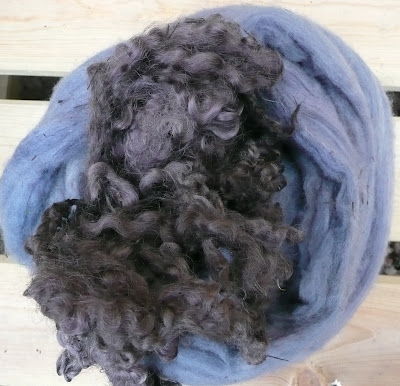
 All the photos are of the same merino and Teeswater curls
The chemicals in the plant must change significantly as the plant matures.But why?
All the photos are of the same merino and Teeswater curls which later will give bright yellow. I had expected pale or non existent yellow