Wednesday, 28 November 2007

Online shop and buckthorn bark

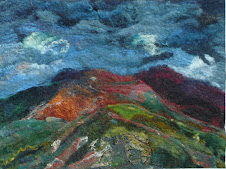
Hurray! My online shop is open. T'is a small thing but it will grow! I have always wanted to have a shop but the idea of standing behind a counter all day is another thing so a virtual shop is ideal for me. Anyway it is open and if you want to felt with naturally dyed fibres this is the place for you. and of course if you want to buy one of my pictures or books.


The only problem with a shop and a blog is that I swear my eyes are going square! However I love my blog and can't think why it has taken me so long to get here and do one. Mind you I notice that nothing very much is getting done in house and garden.


Update on the Buckthorn bark.

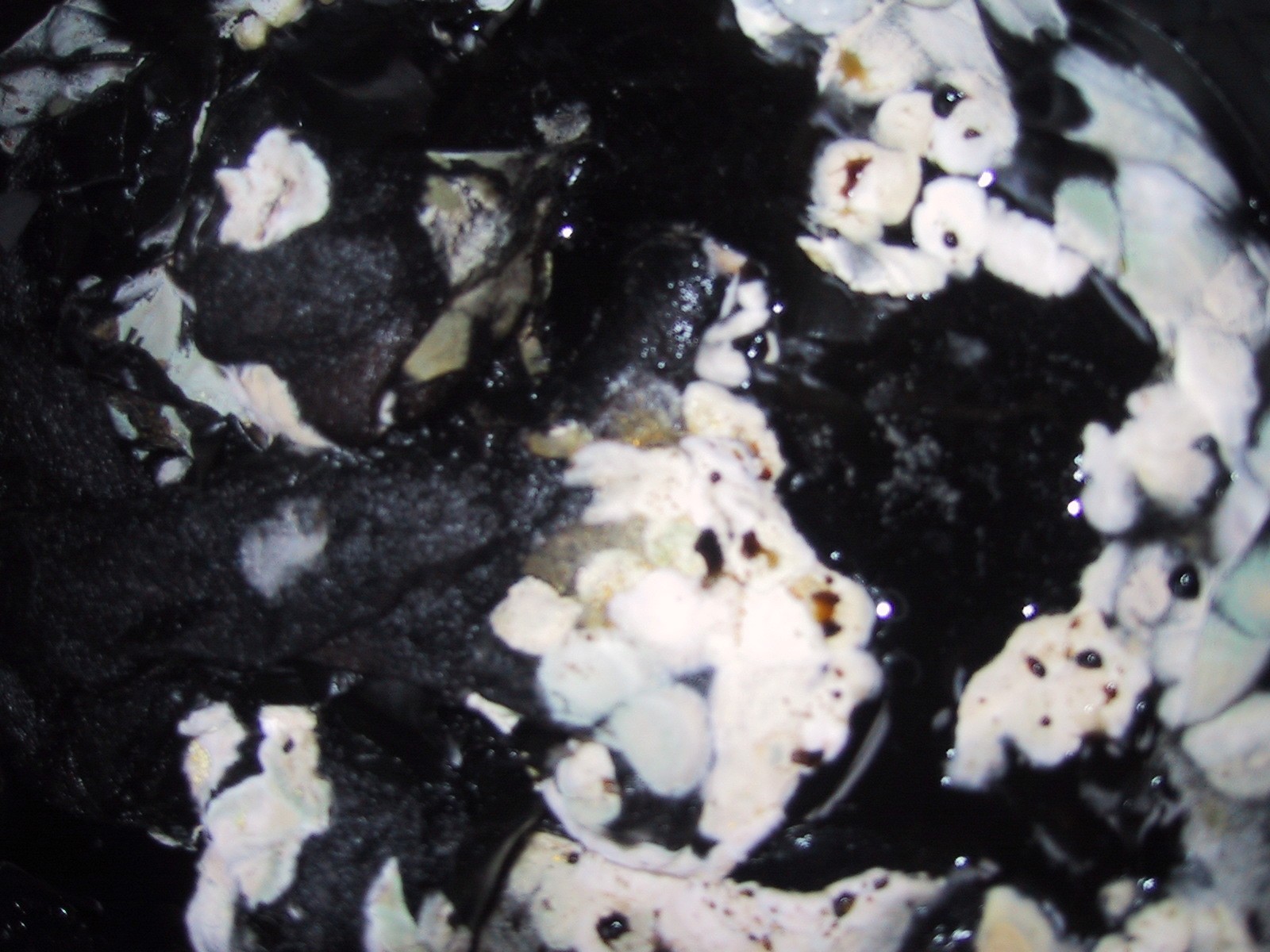
I have uploaded the yellow fibres dyed with buckthorn bark. It is a lovely soft golden yellow but goes orangy/pinkish with ammonia. I tried the full colour modification a la Fred Gerber. The original mordant was Alum @ 8%A 7%CT. Then I split it into 8 pots with about 50ml of dye and a drift of the merino tops. I added a grain or so ( it is not terribly precise I am ashamed to say) So the first sample is alum only. 2.alum + ammonia. 3.Tin. ( ie stannous Chloride. 4 Tin+ ammonia.5 Copper ( copper sulphate) 6. Copper + ammonia 7.Iron ( ferrous Sulphate) 8. Iron + ammonia. The copper and ammonia is a nice colour a sort of purplish brownish pink. Very much the colour the birch trees look at distance when they have lost their leaves. The fermenting one is still bubblin gently away at about 45 degrees C and a pH of 7. I dropped a tiny drift of merino fibres in and for the first two days these looked a deep brassy yellow now they appear to be taking on a russet hue.
I am really looking forward to seeing the fermented result and then I shall try it with alder buckthorn and I hope beechwood ash, the first I have ordered and the second I shall have to create using beech wood chips which now no less than three woddturners have promsied.
I discovered that a friend Debbie has a 1lb of blackoak bark. This too I have never tried and I really want to having heard what a fantastic lighfast yellow it makes and is very strong. So Debbie gave me 100g to try out along with some whitebark oak she bought in error to see whether that gives any result. These two are now in soak so I am hoping to dye with them over the next few days. Black oak bark has not been possible to get hold of till recently and not at all in the UK and I know that Bill Bailey, a member of natural dyes online harvested a lot, which he sold to Hillcreek Studios & Aurora silks. This particular batch came from Earthues.
Back to brief comment on woodash. Hi Leena I think that juniper is an alum accumulater and so works as alum mordant ( but I could be wrong).


Monday, 26 November 2007

woodash lye

Leigh said she did not realise that there was a difference in wood ash lyes. I don't know that there is and Leena commented yesterday that it may have been just the ash of local trees. However when researching for my indigo book I did find that the recipes for fermented indigo called for a wood ash lye from oak. But I managed perfectly well without it. Yesterday I had a stall at an art fair and met up with a friend who as well as making fabulous baskets ( which I use on my stalls) has a husband working in a oak frame business. They reconstruct ancient building etc. as well as building stunning summer houses in oak. She feels he can get me oak chips to burn and possibly beech. Another wood turner ambling past my stall also said he could get me beech chippings so I may be able to try these all out. Incidentally wood ash lye is not difficult to make. There are all sorts of fancy instructions for dripping water though straw etc but I find just pour water onto a thicklayer of woodash in a bucket and leave for a few days does the trick.

The buckthorn bark is bubbling away the pH has now dropped to between 6-7 and the temperature has risen to 45 degrees C.

Sunday, 25 November 2007


On the left Buckthorn bark and water on the right the same but with woodash lye.
The Bark with woodash lye has now been sitting on the heating pad for two days and the temperature, initially 50degrees C dropped to 40 and has stayed there, just dipping below on the first cold night. The pH of the woodash lye was 11 so I was surprised this morning to find the bark on the heat pad ( dyebath 2) fermenting with bubbles on the surface. The pH is 7-8. The liquid looks a strong reddish brown. I am not sure I am supposed tobe fermenting the brief recipe in Dominique Cardon simply says cover with warm woodash lye for 8 days. It is an old Dutch recipe apparently so if there are any dyers dropping form Holland it woud be interesting toknow if they know of this. Thanks Leena for your comment about lye. I think ( and hope!) you may be right but it would still be interesting to try and get some beech ash just to see if it makes a difference, I suppose it depends on what happens at the end of all this. The Buckthorn bark has to stay heating for 8 days then the wool needs to be immersed iin it for a week turning occasionally. I assumed it should be topped up with water because I have only covered the chips so there won't be much liquid otherwise.
The bark covered with water had a prolonged heat in a slow cooker at the keep warm temperature which keeps it well under the boil. I rarely boil as it so often dulls the colour. Now it loooks rather like rhubarb root what my a friend calls an unky yellow, in other words mustard. I shall dye with that tommorrow I hope.
I am off to an Art Fair now car all loaded so must dash.

Friday, 23 November 2007

Updates on purple loostrife and alder.

I have been eyeing up the purple loostrife bath has been sitting on the floor of the studio for the past week because if not quite the inky black of the eucalyptus bath it is a dark charcoal now. I have been wondering whether the bath is better when it has been left giving the iron time to form the iron tannin complex that I understand gives the black. So today I put in 50g of merino tops and have left it heating gently. If you put a finger and thumb in it feels almost as though the bath is slightly thick and you can rub a black slime between your finger and thumb.

In answer to Leena's comment I have used logwood for black and have a very good recipe which Jenny Dean helped me develop and it gives an excellent black with iron ( I used it in my picture Rising Sun ) but I need a black for my medieval hat maker who can't use logwood and also because I want to see whether I can get the colours you are supposed to be able to get from such plants as Pl and elecampane. My final reason that my dye garden will be opened next year and I want a sample of every dye plant in the garden. My work may be cut out as Enys who does the garden has gone to America is meeting up with a professor of a botanical garden with a view to getting exotic seeds The dark green sounds very interesting and I shall try that as a dark green is so useful. Thanks Leena

In the meantime I decided so see whether I could get hold of any alder bark, none of my suppliers seemto have it, but my eye was caught by alderbuckthorn (Frangulaa Alnus)Much excited I looked up the name and found it is a variety of buckthorn not an alder and is not a dye I have used very much. As I browsed through the pages I found you could ferment the mature berries of buckthorn for a lightfast purple At this moment my thoughts digressed and I found myself remembering a time not so long either when I thought I knew a lot about natural dyeing. Now the more I do the less I seem to know. Anyway that is a digression . On reading about alder buckthorn I was interested to find that if fermented in beechwood ash lye it would give a madder type red. I dived into my dye box and found at the bottom a kilo of buckthorn bark-then I discovered you could do the same recipes with buckthorn bark as for alderbuckthorn So Dye bath 1 is 200g of buckthorn chips which I put into soak. The water went bright yellow immediately. Dyebath 2 is 200g of buckthorn covered with woodash lye.-2.2litres. This I then heated to 50degrees C hauled out a hot plate and placed it on it as the recipe said to cover the chips with warm wood ash lye ( it should be beech ash but I did not have it) for 8 days. This time the liquor turned bright red.

I feel very excited. What is it about creating colour that is so life giving? I just love it. :)

I want to get some alderbuckthorn and also some beech ash for beech ash lye. In fact I can't wait and am racking ny brains for someone who works in beech.

The recipe incidentally came from Dominique Cardons book Natural Dyes which represents for me £75.00 very well spent even if the chemistry is mostly over my head!

Wednesday, 21 November 2007

Blacks Alder and a Nice Day


Today has been one of those days that happen occasionally when everything nice seems to happen. I went to visit a centre in Ruthin ,a nearby medieval market town , called the Chiron Centre ( website up soon)and took with me two of my pictures. The sense of peace and a beautiful space was quite overwhelming. beautiful wood beams, wattle and daub walls painted gentle creams . Every window showed stunning views, one over the medieaval buildings of Ruthins market place with a view of distant hills beyond one way , and a view of complex roof shapes with the outline of the Clywdian hills against the sky the other. Angela who has opened this glorious place for meetings, gatherings, alternative therapy, yoga etc has offered me an exhibition and two workshops in the new year. Then I return to find that I have two lovely comments on my blog. I have been loving my blog it is keeping my mind focussed, however having lovely supportive and informative comments too is the icing on the cake. Thank you Bettina. Leena and also Leigh who hasen't popped into today but has many times over the past two weeks.Onto the alder. It seems to be that a lot of iron is needed to get the black, as apparently three were statutes about it use as black because of its effect on fibres.20-25kg or alder bark are added to iron filings with 6 litres of vinegar to 1lb of rusty iron with one twentieth of the liquor being decanted three times a day and poured back in -presumably to aerate it. Thsi was left for at least a month. ( Dominque Cardon Natural Dyes p426. I must read Jenny Jeans recipe for blacks becasue she has a number in her latest book and she did a lot of research on the medieval blacks. My trouble is is that as I dye very fine fibres ( merino64's and 100's ) I neither want to do a lot of overdyeing as it felts nor do I want a lot of iron as it destroys. hum!May be I ask too much! And I quite want it to be local too so alder would be very nice. I was so interested to read Leena's comment tha the leaves were use for a tonic for the animals- so often dyes and natural medicines seem to go together. Black is not only difficult in natural dyes though my GP mentioned to me that she often sees people who have a skin reaction to synthetic black dyes as there are very few. Just to cheer us all up I have uploaded a photo of my boiled madder from the chips that gave that fantastic red. The only thing is that the photo come out quite pink in colour when really it is burnt orange . It was heated overnight but at just under the simmer. I was surprised to see it still had so much colour but it was in soak for at least a week between being used for the red and oranges and being used again.

More on Purple Loostrife and Indigo books


Well the purple loostrife has turned out a very pale grey on wool, a charcoal on silk. It was paler than I thought it would be as the bath is a black and seemed to be full of colour a little bit surprising. It could have been because the plant had really gone to seed so all the energy has gone into making the seeds , could have been because we had so little sun this summer. Could be because of course it contains very little dye. I will have to try and make sure I dye with it earlier next year.
My dh thought it was white.
Incidentally the yarn is not handspun by me but by Elaine Williams of Trefriw Woollen Mill who has a lovely dye garden. She is a very busy lady running a family business so sends me her handspun yarn and I dye it for her.
I have had an email from another dyer suggesting alder bark as a source of black. On reading about this I find it was a source of good blacks... a softer and bloomier black *......... not as harsh as some others, although it was considered destructive for fine wools, but of course it would be local ( the very name is considered celtic) and my source for much of this information Dominique Cardons book says that a silk dye works owned by Joshua Wardle in the 19th Centruy used bark cut in Cheshire, the county next to here. The bark has to be cut in spring and I would need to find a local source I am not sure I can cut bark form trees on someone else land.
A couple of weeks ago I adverised my indigo book the Colour of Sea and Sky, The Art of Indigo dyeing on natural dyes online and sold a lot of books very quickly. It s quite exciting to find them whizzing off to Australia, The Falkland Islands , Trinidad, Hawaii, Canada and the USA amongst others and I have a sense of invisible connecting lines linking us all to one another. Yesterday I got my first feedback, an Amercian Dyer sent me an account of her first days experience of using my instructions for the reduction bath-my favourite- she had a huge success with it and gives me a thrill to know that my instructions work adn the book has given pleasure too. An indigo vat is so much easier taught visually than anything else. Thats a thought maybe I could done on this blog .hmm
*Dominique Cardon Natural Dyes p 426

Friday, 16 November 2007

Dyeing for a Hat

I have just had a very nice commission to dye 300g of merino for a mediaval felt hat . We have settled on the madder brown but instead of using the madder chips to boil with after all the other colours have been extracted I am going to boil the chips straight off after a soak of a few days at least. I have not done this except by accident when the resulting colour was absolutely fabulous some years ago and the person for whom the hat is intended is more than happy being herself very familiar with madder colours. So yum! ( I think I will sneak in 100g for me!) In fact late as it is I think I will sneak out to the studio while DH is watching Children in Need and put the madder into soak.

The purple loostrife is rinsed. A huge amount of colour rinsed off and as I suspected I will be left with a pale grey. A photo will appear when the fibres are dry.

We have had two very cold nights here ( well for us) one night of a heavy frost with crisp grass and white roofs). The Japanese polygonum is however looking very happy and in full flower!Someone on Natural Dyes Online said she suspected that it is hardier than generally thought and it looks as if she might be right. The last of the woad looks a bit limp but is still hanging in there so I hope to get a play with that on Sunday.