Tuesday, 30 September 2008

Pictures, a creative surge and panic stations


Posted by Helen


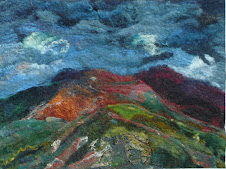
Last Saturday I ran a felt jewellery workshop for the Rowan Art Gallery in Mold. Their gallery is made up of movable walls - a brilliant idea , and a long time ago ( as in sometime in the spring) they asked me if I would like to have a wall at the gallery for three weeks . I thought this was a wonderful idea as it means I can put a lot of my work together without having to have 30 or so pictures and the courage for a solo exhibition , so at the workshop , which went really well, they asked me is I still wanted it. "Great" I said "November"? "No, October 20th"! Oops. Fortunately I have been doing a lot of paintings which are the start of making my pictures and some felt making and quite a lot of thinking about my next pictures. So I set to and got going and and suddenly a creative surge swelled up from inside me! . Tim and Chanel who do all my framing for me ( The Cathedral Framers St Asaph), said they would frame anything I could produce up to a week before. So over the last few days three pictures have gone to the framers.
Falling Leaves.

Stormy sky and hills 1
Srormy sky and hills 2

Saturday, 27 September 2008

All the Coreopsis in the garden!

Posted by Helen
Merino tops dyed in Coreopsis tinctoria after the Teeswater Curls in the previous post. Glug of ammonia added to bath.

Perennial Coreopsis


Tiger's eye Coreopsis Tinctoria
Coreopsis Tinctoria in an open sunny bed which is where it does best
Close up!


Wednesday, 24 September 2008

Coreopis Tinctoria


I remember my excitement when I first had coreopsis tinctoria, as it gives such wonderful shades of yellows and oranges . So I persuaded Enys to plant lots in my garden. All over this summer Enys and I have been picking the flower heads and drying them. Getting ready to a jewellery workshop last week I decided I could do with some clear bright oranges for felt beads. Casually I tipped the latest bag of dried flowers that Enys had brought round, from her garden into a pan covered them with water and put on a low heat. I popped in a handful of mordanted teeswater at the same time to see what colour came out. Usually it is a yellow that goes to a orange with ammonia. Look what I got this time! An orange that has given an orangey red with ammonia. Yummy. Mind you it is probably about 300% of flower heads to fibres so I shall treasure it. In the meantime it is a colour to brighten up a dull September day! And cheer me up as having nearly set the studio on fire last November yesterday I flooded it. One of the brass taps on my old chemistry lab bench sprung a leak or being more realistic I did not quite turn it off and the studio was literally two inches deep in water yesterday. It took DH and I about an hour an d a half to get rid of all the water but as I had to clear out all my boxes it now looks quite clean and tidy.


Yesterday we had a lovely sunny afternoon and here are some photos I took of my favourite dog walk. The hills are often part of my landscapes , although at the moment I am doing a series of hills and stormy skies.

Friday, 19 September 2008

Lythrum Salicaria and Baptisia Australis


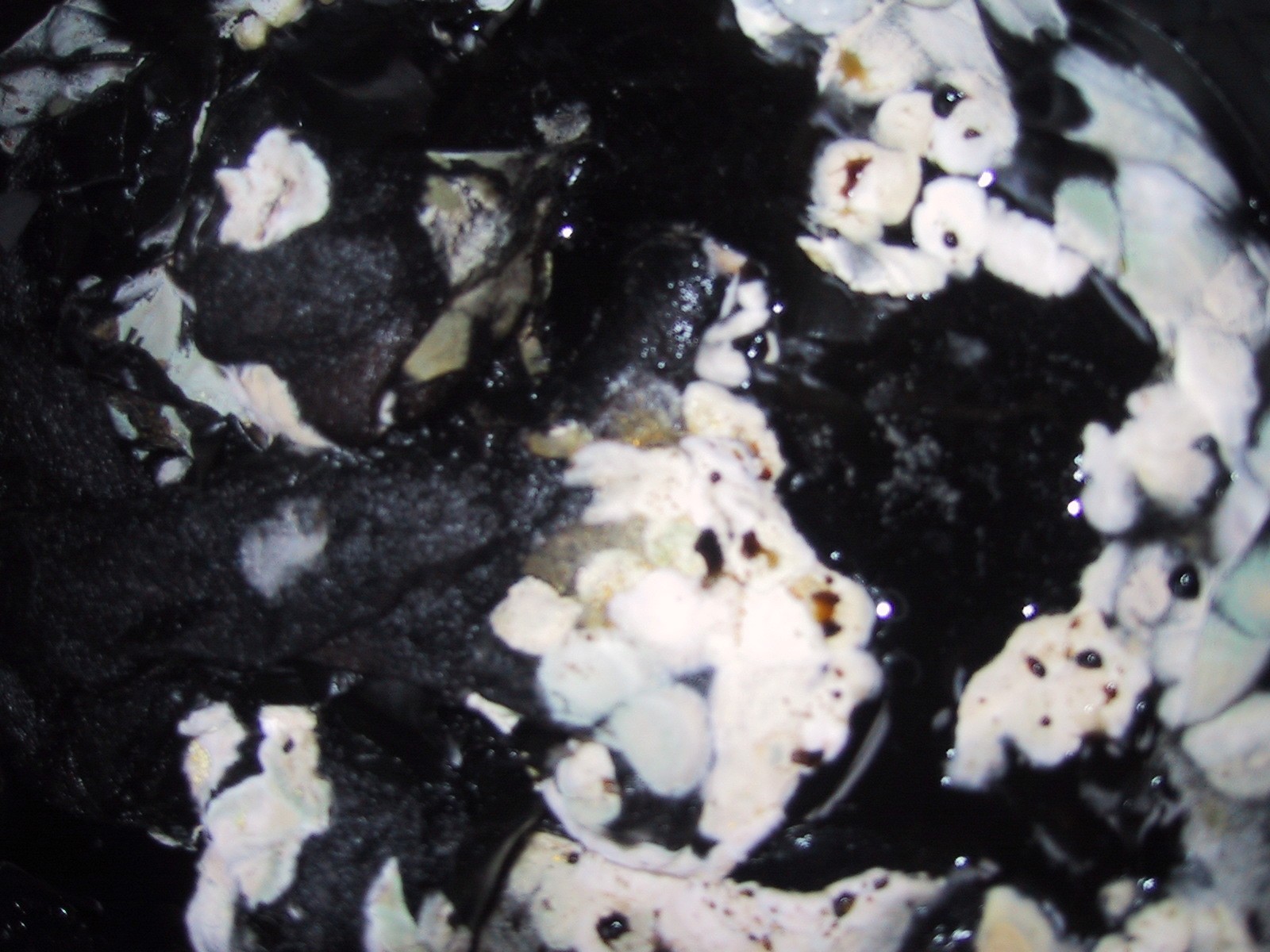
Top is the baptisia I mentioned in the last post which has come out a dark yellowy gold. "A Renaissance colour" says Enys approvingly. The Lythrum Salicaria produced the very black dye bath with a teaspoon of iron. Alas! Alas! It washed out of the fibre and gave the grey you can see in the picture in the top photo.


Thursday, 11 September 2008

Baptisia Australis

Posted by Helen
Photo shows the Baptisia Australis propped up by the pole. Hanging over the top is the flowering head of Persicaria Tinctoria -note the sun putting in a rare appearance!
Today while picking rhubarb leaves in Enys garden I mentioned I was going to see whether there was any indigotin in my Baptisia Australis of which I have one in a pot outside my sitting room window, at which Enys promptly dived into her jungle and heaved out a great bunch of it. Weighed it proved to be 150g with stalks.

When I got back I went to check the details in Dye Plants and Dyeing by Margaret and John Cannon (published by The Herbert Press Limited in association with the Royal Botanic Gardens Kew) one of my "bibles" of dyeing and realised I had made a stupid mistake. It is Baptisia Tinctoria which is repute to contain indigotin, the Australis is said to give a green with the leaves. I checked with Enys who said it was definitely the Australis we both had as she can't get hold of the Tinctoria .

So I chopped up the leaves and stalks and put them, covered with water, in a pot to dye, which now means my last available heat source in the studio is in use. The two hot plates are fermenting madder and indigo. In the slow cookers are weld, golden rod, madder and now Baptisia Australis. One electric ring has a bath from Lythrum Salicaria which dyed a brown yesterday. I have just added 1 teaspoon of iron to and to my delight it looks as if it going to go black, previously I have only got a grey from purple loostrife. On the other electric ring is the 1.2 kilo of rhubarb leaves being gently heated to produce oxalic acid and the final pot contains 400g of 18.5 micron merino being mordanted in preparation for a big dyeing session ready for Felt Stoles at Burton Manor. And I am going to have a glass of wine!

Monday, 8 September 2008

Enys finally gets a word in edgeways

From Enys
Finally and at last (if of course this works) I've got onto our blog. Now of course I can't think of anything intelligent to write. Helen is working really hard with all the dye plants that we are both growing, how she puts up with my nagging her (to try all the odd plants that I find in some obscure book I've found) I really don't know, but she always indulges me!!
As you can see my Indigofera has been used and I can now see a little bit more out of the kitchen window, the two small ones which I brought in from the greenhouse are much happier and have really begun to shoot.
We still have a mass of Dyer's chamomile to pick once it dries up, and the greenhouse is still has many Persicaria plants seeding nicely for me. I've potted on some Chinese Wood in the greenhouse into bigger pots, I'm leaving some outside - but in case I lose them. The rabbits and pheasants are a real pain, they even ate some newly planted roses that I had carefully grown from cuttings, had to cage them in wire. The rabbits also pruned my Echium vulgare (Vipers bugloss), Dyer's chamomile, and Coreopsis (actually I must admit this did create very bushy plants, so it wasn't all bad). They didn't like the taste of Phytolacca americana, that was probably too foreign for them.
I hope I remember how to get this on the blog.
Enys

Saturday, 6 September 2008

Indigofera Tinctoria

posted by Helen


Yesterday I went over to Enys's house and she carefully pruned her nurtured and much cared for indigofera plant. Enys loves this plant; she says it is partly because it folds it's leaves up every night, but it is also because getting it to germinate proved challenging and growing it even with a greenhouse has been difficult. Now, however, she has got the hang of it and there are two other seedlings coming along nicely on her kitchen windowsill. It germinates in the greenhouse but seems happier in the kitchen and as she has an Aga the temperature probably stays fairly even. This is a plant that has been really looked after just as if it was baby which explains why she won't let me near it with her pruning shears and her DH ,an expert gardener, was drawn into a discussion on how much to cut off without endangering the plant.


The leaves weighed 100g, 76g after I had stripped them off the stalks. I ripped them up and put them in an 1 litre pot with a lid and placed them in a larger pan. I covered them with water and placing in a double boiler and heated till 60 degrees C


There was very little colour in the little vat so I left it overnight as a member from Natural Dyes Online had suggested. This morning ( Sunday) I had a look at it and it was still barely more than pale yellow so I chopped the leaves more finely and reheated in the double boiler and repeated to about 80 degrees C. The water was now murky yellow green , but I put 1 teaspoon of washing soda and had a pH of 9.8: too high I wonder whether the washing soda which is a new batch is unusually strong, and whisked till it was very frothy. The froth was quite white . By this time I was becoming convinced that there was no indigotin at all, but I added 1/2 teaspoon of thiourea dioxide to the vat and left it for ten minutes and put in a few strands of throwsters waste, which looked white as it went in rather than yellow. Now I was convinced that there was nothing there and was wondering how to tell Enys that her precious plant had produced nothing. when I pulled out the silk. To my astonishment the edge of the silk turned a turquoise blue. I tried re dipping and finally I got a pale blue silk and a pale turquoise blue 10 g piece of wool. I am a bit surprised how turquoise they look and felt the result has been more like the colour obtained by dyeing with persicaria (polygonum) tinctoria.


So there was not much indigotin there but some and I feel very pleased to have tried as I have now successfully used all the four plants that we grow and that will give blue. I wonder whether the lack of sun has been a factor but it is more probably that it is a tropical plant growing in conditions which are far from ideal for it. Well I will try again next year provided of course Enys lets me.