Showing posts with label dyes from the garden. Show all posts

Wednesday, 28 July 2010

Visits to the dye garden, the BBC and Hopi Red Dye Plant

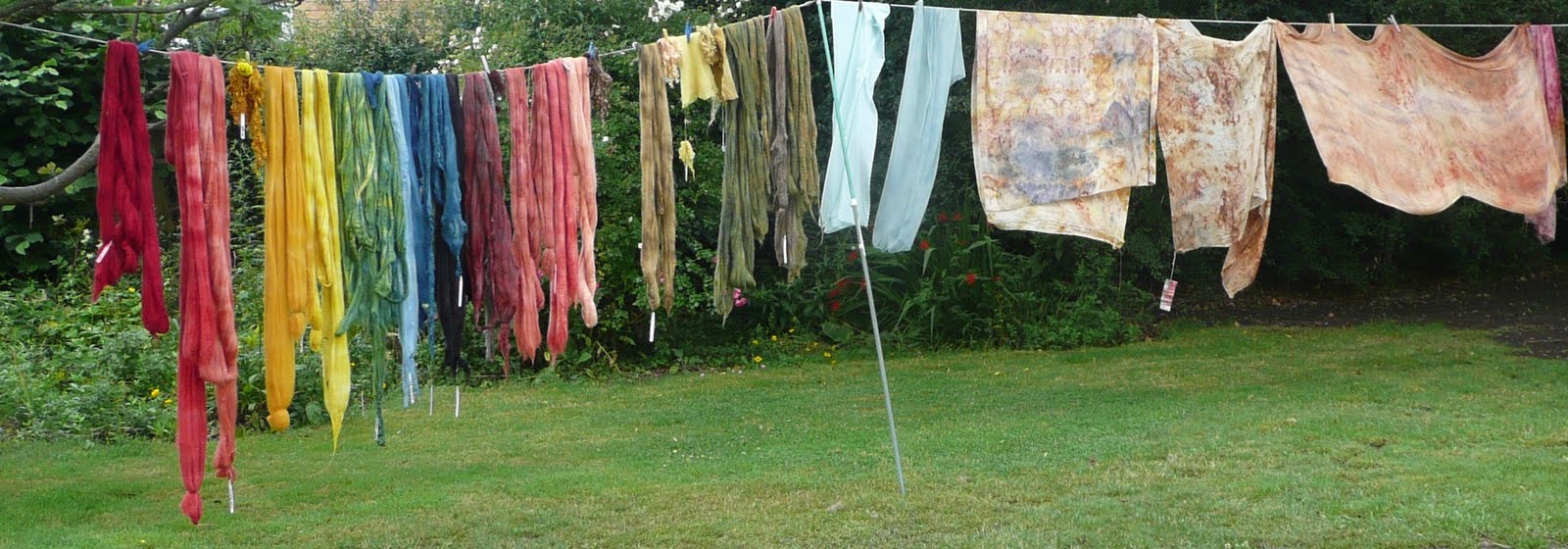
Last night DH said with a huge sigh of relief.  " Good! We can have a lie in tomorrow" This is because over the last few days we have had a textile group from Iceland visiting the dye garden and having a two hour workshop in the summer house and then two days later the BBC came to film the dye garden and what the director insisted on calling the " Dye Lady" for a Children's science programme called Nina and the Neurones.   Hence DH's  sigh of relief as it is he who rushes around mowing the lawn and setting up tables as well as removing dog particularly  from the filming day  (Because of  unwanted woofing)  while I work hard but get all the glory.  I was too  busy to take many photos  but I have put one up of the washing line. Everything on this line was dyed using either plants in the garden or if not quite that by plant material that I also grow. (Except I realised belatedly the red on the extreme left had some cochineal in).   This was in response to the BBC wanting a rainbow of colours on the line and was filmed a lot so it was worth the work. The yellows are Rhubarb root,Rheum spp, Gensita tinctoria and Tansy Tanacetum vulgare . The greens are Genista tinctoria and woad  Isatis tinctoria.  The blues are either woad Isatis tinctoria  or Persicaria tinctoria (which also dyed the blue silks) . The mucky greens are a patchy pale indigo overdyed in rhubarb root. The really dark almost black fibre is somewhat  surprisingly alkanet which I left on too high a heat so it boiled.( This is following extraction of the dye in alkanet by acetone) . The fabrics are silks dyed as solar dyed bundles .


Well I am  here typing, because  while DH is snoozing peacefully down stairs with dog,  I am upstairs in my office having -and this is sod's law- woken up early! So I thought I would share with you my experiments with hopi red dye plant. Amaranthus .whatsit I have been told by a friendly comment that this is A. cruentus x A. powellii,which is just as well as every time I ask Enys she looks vague!
Enys tried to grow this two years ago,  The seeds did not germinate so she threw the compost onto the greenhouse floor in disgust.  The following year she noticed she had lots of  little red plants growing on the green house floor. So she planted loads in my garden and in her own and in the green house.
When it came to dye with them I could find out very little.  None of my dye books -even the one Enys bought back from the USA on native North American Dye Plants contains any information beyond the fact that the Hopi Indians used it for dyeing corn in ceremonies.  A quick search on Google was not much help either resulting only in  that the Aztecs also used it in some ceremonies around blood.


So I picked a large handful of leaves and flowers chopped them up covered with water and added some pre-mordanted silk and teeswater fleece and heated in a slow cooker.   The teeswater went orange and the silk pinks as you can see but the pink washed out.  I added some  more fibres to the  dye bath and everything went a deep vivid pink.  About an hour of heating it all went orange and then another hour ) the colour had almost  gone and all I was  left with was a beige.
Aha! I  thought to my self,  this plant is a candidate for long slow dyeing , along with red cabbage and others where the dye seems to be destroyed by heat. (the only information I could gather was that the dyes are anthocynanins).

I had a friend here for the afternoon who often gets pressed into helping me and she suggested that we split the plant.  So we made up three solar  pots one of leaves, of stalks and one of flowers.
These are now sitting  in my sunny place waiting for some really hot sun to get going.  All the pots have now dyed the fibres a deep pink.

Saturday, 28 February 2009

Rhubarb Root

Posted by Helen
It has been such a long time since I wrote in my blog that you might be justified in thinking that I had vanished from the face of the earth but not so! I am here alive and reasonably well. Following on from the previous post was surprisingly daunting, and besides I thought having made the effort to write such a long blog I might as well leave it there to be read for as long as possible.

On February 21st I ran a dyeing workshop for region 11 of the International Felt Makers. It is a while since I have run a dyeing workshop with immersion dyes as opposed to extract dyes apart from in my own studio so I had forgotten the huge amount of preparation involved. I seem to spend days mordanting a variety of wools,silk and such like as well as planning out the day like a military operation with all the baths with their own start and finish times. Dyes were soaked, heated and extracted and then all had to be transported to a hall up the road. In the end the work was worth it, the students seem to have a good day and it all went smoothly apart from my forgetting to strain the brazilwood bath so all the wool samples were tangled up with tiny chips. We did have one or two surprises and one was the rhubarb root bath. I had included rhubarb root because I always classify it as a substantive dye as I thought if I was short of time to mordant I could put in unmordanted fibres. I was surprised to find when researching that Dominique Cardon classified it as a mordant dye despite it being high in tannins. I had forgotten too that Su Grierson had experimented with Rhubarb root and had got a coral red when she soaked the rhubarb root in water with ammonia added for five days. I decided to do that for the workshop and then realised I also had large jam jar with rhubarb root soaking on my studio window sill where I had been sitting forgotten and neglected since last August. The fibres dyed in my rhubarb that had been soaking since last august-these are on the left of the picture - came out a dull soft pink very like the colour of stewed rhubarb.The rhubarb in the workshop came out a very deep mustard yellow almost a gold, added ammonia turned it into a deep brown with red and gold shades shot through the fibres. The fibres on the right were dyed in the exhaust with dash of ammonia added. Both fibres were mordanted with 8% alum,7% cream of tartar

I took some photos of the workshop but they were hasty and came ut looking blurred and poor. -I find taking pics when I am running a workshop is quite impossible.I need a resident photographer I have decided!
Below are the notes I wrote for the workshop
Rhubarb Root
Rheum sp

The rhizome of the garden rhubarb root belongs to the same group of dye plants as docks and sorrels which are described in Dominique Cardon's authoritative book ”Natural Dyes” as the russet dyeing polygonaceae.

Rhubarb originated in Mongolia but is now widespread in temperate climates and is used by Tibetan refuges who also use the leaves, which give oxalic acid, as a mordant and the stems as a ferment for the indigo vat. The rhizome of the ordinary garden root contains complex tannins, the result is a bright mustard yellow dye that a dash of ammonia will turn pink. I have always used this as a substantive dye, that is one that can be used without a mordant, but Dominique Cardon describes it firmly as a mordant dye when it will give orange. It is not often found in the ol
der dye books probably because it was not established in the UK till 1758 (Grierson). However Su Grierson while exploring traditional Scottish dyes experimented with Rhubarb rhizomes a lot and got a range of colours on mordanted yarn from greys, topaz, lake and coral reds and it is a variation on her recipe we used in the work shop
Recipe
Starting 5 days before required
  1. Use 50% Rhubarb root to WOF (Weight of dry fibres)
  2. Cover with water
  3. Add 1 tablespoon of household ammonia/100g
  4. Leave for Five days
  5. Put into a dye pot with sufficient water added for the fibres to move freely
  6. Enter either pre-mordanted and un-mordanted fibres heat till the water steams and hold for an hour hour
  7. .Allow to cool
  8. Rinse fibres
Notes copyright Helen Melvin February 2009

I am now busy getting ready for the next lot of workshops-five in March. Too many really as I still get very tired and still don't feel quite myself. The consultant was spot on when she said

I would need 6 weeks convalescence but it would be three months before I felt quite right. :(

Welcome to all the new followers to my blog.

Helen

Saturday, 17 January 2009

Friends, Dye Garden, Mordants , Health and textured yarn

Posted by Helen
Where would we be without friends? My friends have always been very important to me but over the last few weeks I have come to value them all very much. This is what one good fairy friend turned up with the other day. Something to crochet with from her own stash, some are handspun yarns and others are interesting yarns she has picked up. yum! yum! . So I made a hat for her. The turquoise is from the merino 18.5 micron dyed with Saxon blue (indigo sulphonate)I dyed a couple of months ago,and spun last week, but I added in some of the sparkly yarn and then some terracotta and purple. Here is the result although I plan to add a large flower.

The second thing she bought (apart from the cherries which I really enjoyed :)) was " A BOOK" ! This lovely book is full of different ways to create interesting textured yarn. Now it may surprise some people to know that I can spin a smooth even yarn if I have too and if I put my mind to it but I get so bored! I can never resist adding something in, so this book is just up my street. The book is Intertwined,The Art of Handspun Yarn,Modern Patterns and Creative Spinning Lexi Boeger ISBN-13:978-1-59253-374-9 published by www.quarrybooks.com.It is full of interesting textured and innovative yarns with clear instructions on how to spin them (although you do have to know how to spin -it is not a beginners book). There are projects too but I rarely want to follow some one else's projects preferring to invent my own.

The Dye Garden -or rather bits of it in January.The first snowdrops are out.When Enys came three days ago there was no sign of them but today here they are. Here too is some very healthy looking weld and my Chinese Woad.


My health is continuing to improve with some minor setbacks. An investigation has shown no further complications,which is very good news. As the Consultant said I have "just" had pneumonia but she did say this is a serious illness and I can expect it to take three months before I feel like my old self :(
While in recovery from my recent investigation I read more on mordanting and also Brazilwood as Debbie Bamford is running a red dyeing workshop on the Online Guild in March. She wants us to put some into soak now as it improves with age. I haven't done it that yet but I will tomorrow.
Mordanting:I have written 7 pages so far on the history of mordanting, the use of mordants worldwide and on alum .What do I do? Extract some of it for the blog or publish the whole lot.What do you think? How much do you want to read about mordanting?

Sunday, 26 October 2008

Cosmos


Here are the results of dyeing with cosmos from my garden .

I picked 300g of flower heads, covered with tap water in my traditional style slow cooker and left this on overnight. The advantage of this slow cooker is that unlike the more modern electric casserole it does not reach boiling but heats to between 80 & 90 degrees C and can therefore be left on overnight without too much fear that the studio will burn down and the colour will be spoiled by boiling. I allowed ( this really means that I was to busy to do anything with it ) it to cool, when the bath was red and then dumped in what I had left in my mordant pot which turned out to mixed fibres of silk laps, Lesley Prior 's Bowmont, teeswater fleece and some 18.5 micron merino. These had been mordanted in 8% alum, 7%cream of tartar and I left them to heat gently for about 24 hours before removing. This morning when I came to check, the dye bath was a soft yellowy green which for some reason does not show up well in the photos. I made samples as follows. I remove about a 100ml - (this is quite approximate incidentally)- of liquid and added to it appropriate chemicals as follows. A small glug of ammonia ( about 5ml) ), a 1/16 teaspoon of stannous chloride , the same plus ammonia, 1/16 of copper sulphate and the same plus ammonia , 1/16th teaspoon of ferrous sulphate and the same plus ammonia. I then gave these a minute in the microwave to provide some gentle heat, remove the fibres rinsed and labelled. The ammonia turned the dye bath a deep gold so I added a glug to the main bath and took a photo after about half an hour of gentle heat.

I probably dyed about 100-150g of fibres but I will check tomorrow when they are dry. I have not obviously done light fastness tests yet but according to John and Margaret Cannon -Dye Plants and Dyeing published by Kew Garden, cosmos sulphurous (my cosmos is in the same genus), is in the same dye group as coreopsis tinctoria and dahlia. Originally they came from Mexico and were used by the Aztecs before the Spanish invaded Central America. I first grew these plants because my mother in the last few years of her life grew them and they reminded me of her. Enys and I think I brought a packet of seeds and handed them to her but we both have been very pleased with them. They obviously have enjoyed the wet summer which is surprising as my mother lived in dry Surrey but they have been fantastic this year. So another dye plant which , like dyers chamonile, coreopsis tinctoria , lythrum salicaria and to a lesser degree genista tinctoria, is both beautiful and useful. The picked plants are already flowering again so will no doubt go in giving pleasure till the frosts come.

Friday, 24 October 2008

No reds but turquoise and artisans.


I started to blog the other day -meditating on whether I had been hit by the recession ( unofficial as yet but definitely here). Well I nearly fell asleep reading it so I decided not to inflict it on you either.

I have been dyeing , but the sort of unremarkable routine dyeing of fibres for lots and lots of up and coming workshops. As I was making up packs I got panicked by lack of certain colours so I have been doing much panic stricken dyeing mostly greens and purples and thisis despite the fact that my studio is a sea of boxes full of dyed fibres. I usually use the extracts for emergency dyeing but even with them and mixing I really have a problem with getting reds, because a) I have soft water i.e. not easy to get red from madder , b) a lot of reds turn towards the purple when felted (it is the alkalinity of the soap that does it). Brazilwood is the worse for this. I then discovered to my dismay I am out of bugs, although I could have sworn I still had a 200g left-
:( so I can't do my favourite cochineal/madder mix for reds. No reds. Ho hum! I have got turquoise though, lots and lots of yummy turquoise, using "green" extract over dyed with indigo.

I am simmering cosmos as I write so tomorrow or possibly Sunday there will be an update on that! ( it is looking promising with a deep orange coloured bath from 300g of flowers).


PS What do you call a craft market when the word craft has been so bastardised. As for handicrafts -bleh. I have come up with "Artisan Market" with a nod of thanks to Karen Casselman who uses this instead of crafts. I would be interested to know do you all who read my blog think artisans is better than crafts person or man/women and is Artisan Market better than craft market?

Saturday, 4 October 2008

Teeswater

Posted by Helen
I always like to have the long wools. They have an irresistible lustre and sheen and look so enticing and some of you may have noticed that my dye sample are often a clump of long wool. It is so easy to pop a handful into the dye pot and they tend to take the dye beautifully with a sheen and a depth of colour that is somewhere between short wools and silk. I have dyed and spun Wensleydale, Leicester long wool and Lincoln long wool but this year I discovered Teeswater. I bought a kilo at Wonderwool and loved it. It has the length and lustre of Wensleydale but costs less. At Woolfest I bought another lot that has been washed . I understand that traditionally they used to run sheep through a river to get rid of the worst of the dirt and the grease and now they are doing this again but not through a river but a something more akin to a sheep swimming pool although I doubt it is heated. I have a picture in my head of a curly fleeced sheep doing a fast over arm through a pool with a disgruntled expression on it's face. I wish I could draw it.

I am not the only one who likes Teeswater. My friend Bettina likes this fibre too and has been dyeing it in tops form
If you want to get some yourself I found an excellent supplier at Teeswater wools who also tells you the technical stuff like staple length and fibre thickness.


Here is my most recent basket of dyed teeswater. Centre is cochineal, then at 1 o'clock coreopsis tinctoria, at 2 o'clock fermented madder and madders, 3-6 o'clock coreopis exhausts, 7 o'clock logwoods, 11, I am not sure -12 o'clock goldenrod exhausts.
Just in case any of you find these as mouthwatering as I do I sell these in an A5 zip lock bag full ( about 75g) for £3.50 +p&P

Friday, 19 September 2008

Lythrum Salicaria and Baptisia Australis


Top is the baptisia I mentioned in the last post which has come out a dark yellowy gold. "A Renaissance colour" says Enys approvingly. The Lythrum Salicaria produced the very black dye bath with a teaspoon of iron. Alas! Alas! It washed out of the fibre and gave the grey you can see in the picture in the top photo.


Thursday, 11 September 2008

Baptisia Australis

Posted by Helen
Photo shows the Baptisia Australis propped up by the pole. Hanging over the top is the flowering head of Persicaria Tinctoria -note the sun putting in a rare appearance!
Today while picking rhubarb leaves in Enys garden I mentioned I was going to see whether there was any indigotin in my Baptisia Australis of which I have one in a pot outside my sitting room window, at which Enys promptly dived into her jungle and heaved out a great bunch of it. Weighed it proved to be 150g with stalks.

When I got back I went to check the details in Dye Plants and Dyeing by Margaret and John Cannon (published by The Herbert Press Limited in association with the Royal Botanic Gardens Kew) one of my "bibles" of dyeing and realised I had made a stupid mistake. It is Baptisia Tinctoria which is repute to contain indigotin, the Australis is said to give a green with the leaves. I checked with Enys who said it was definitely the Australis we both had as she can't get hold of the Tinctoria .

So I chopped up the leaves and stalks and put them, covered with water, in a pot to dye, which now means my last available heat source in the studio is in use. The two hot plates are fermenting madder and indigo. In the slow cookers are weld, golden rod, madder and now Baptisia Australis. One electric ring has a bath from Lythrum Salicaria which dyed a brown yesterday. I have just added 1 teaspoon of iron to and to my delight it looks as if it going to go black, previously I have only got a grey from purple loostrife. On the other electric ring is the 1.2 kilo of rhubarb leaves being gently heated to produce oxalic acid and the final pot contains 400g of 18.5 micron merino being mordanted in preparation for a big dyeing session ready for Felt Stoles at Burton Manor. And I am going to have a glass of wine!

Friday, 1 August 2008

Garden bursting with dyes


This is the time of the year when I feel almost overwhelmed by the anount of dye in the garden. I have a sense of the dye garden exploding with colour. Dyers greenweed (genista tinctoria is bursting into flower, golden rod (solidago canadensis) is almost in full bloom, There is loads of yarrow ( achilleia miliefolium) and meadow sweet, the dyer's chamomile (anthemis tinctoria)is awash with golden flowers and the dyer knotweed polygonum inctoria and Chinese woad (isatis indogitica )in the new bed are doing really well. The colours are strong and vibrant too.

What is a poor dyer to do? Surprisingly enough during the year the yellows and greens are the colours I most often run out of, for example the green I made from overdying the yellow from dyers chamomile with indigo has already gone into making a bag , ( the one in the middle top). So this year, I thought I would dye a lot especially with the genista and with the golden rod as neither of these seem to give such a good colour after drying. I don't think that weld does either but it is such a strong dye I don't think we realise how much is lost. Sometime ago Kevin from the Online Guild of Weavers Spinners and Dyers generously sent me his method for making an extract from weld so I think I might try this. Then I found myself thinking maybe I would freeze some golden rod as our freezer is seriously underused. I wonder whether anyone has tried this I know Bettina http://woollybits.blogspot.com/ freezes dyers chamomile and India in EcoColour says she freezes a lot so I might try that.

Leena of http://riihivilla.blogspot.com/ I can't seem to be able to work out how to put a name into the blog which you click on and it goes to the site so Iam having to do it the long way round and give the url) has been dyeing with polygonum tinctoria and has used it to dye wool, rather than the silk I used and got a lovely soft blue with a turquoise cast. I think she kneaded the leaves more thoroughly as she seemed to get more dye than I did. She also pointed me to the turkey red website http://turkeyredjournal.com/ which had an article on dyeing with the japanese polygonum which said that the plant was ready when the leaves showed blue spots so maybe some of mine had been picked a little early.

Sunday, 13 July 2008

Dyers Chamomile Anthemis Tinctoria


Today Enys and I picked 1.7 kilos of Dyers Chamomile from her garden where it grows better than in mine-why I don't know.


Dyers Chamomile is apparently a European plant that spreads as far as the Himalayas but was not much used in Europe as weld and sawwort were considered better dyes and this probably explains why, although Dominique Cardon1 has a section on the plant pigments found in Dyers Chamomile, she does not have a section of recipes, but nor does Jill Goodwin in the Dyers manual or Su Grierson in Colour Cauldron so maybe it also was not used or does not grow in Scotland or the North of England. John and Margaret Cannon in their lovely Kew Garden book with the beautiful illustrations -by the by one of my favourite and frequently turned to dye books- mentions that Dyers Chamomile was used to dye the Turkish carpets2 although Dominique Cardon says that this was the wild chamomile . Jenny Dean in Wild Colour 3has a page for dyers chamomile and also used the plant stem and leaves to get a soft green , something I must try this year.
All those who do talk about Dyers chamomile say that it is easy to grow which it is. You can often get it in garden centres as it is very pretty plant to have in the garden. It also dries extremely well with no apparent loss of pigment in the drying process but is considered to have a poorer light fastness than weld. My own light fastness tests were done a few years ago when I kept my samples for a year in in a north facing window when there was a significant loss of colour. Now I follow a more standard procedure mentioned on Natural Dyes Online and expose to light in a southwest facing skylight for a month with a standard indigo dyed sample alongside as a control. This I need to do this year .

I have been reading about the chemicals that give the dye colours in these plants. The general group the dye pigments come under is the Flavonoids and when these are dilute they are almost colourless. It is only when the molecules are clumped together or when they are bonded to metal ions that they appear yellow. A mordant therefore not only bonds the dye molecule to the fibre but is also essential in intensifying the colour and this would explain why John and Margeret Cannon commented that wool without a mordant was almost colourless.
Like so many dye plants dyers chamomile has a number of different plant pigments, Apigenin (which was the only pigment in wild chamomile) and is also found in weld, and luteolin also found in weld. Apigenin and luteolin are flavones. I mention weld as I wondered why when dyers chamomile shares at least two of the pigments found in weld which produces one of the most light fast yellows that dyers chamomile is not as light fast. Apparently according to Dominique Cardon from whom most of this information comes, this is because minor variations in the structure of the molecule is highly significant. The other pigments , according to Margaret and John Cannon in Dye plants and Dyeing are the flavonols quercetagetin, and one I can find nothing about, patuletin. The flavonals are more light sensitive. I went into all this because I was reading a paper about growing Weld (reseda Luteola) Dyers knotweed (polygonum tinctoria) and Dyers chamomile written by Anna Hartl and Christian Vogl ( The Potential use of Organically grown Dye Plants: experiences and results on cultivation and yields of Dyers chamomile, Dyer knotweed and Weld published in the Journal of Sustainable Agriculture 23(2) 2003. Here the author said that the main components of dyers chamomile had have not yet been identified,which I found most surprising and what started me off on reading my various books.

I can understand why Dyers chamomile would be considered as a source of yellows for the organic textile trade as it is easy to grow and apparently to harvest. Think how gorgeous fields full of dyers chamomile would look too so I hope that it does happen.

In the meantime I have put 200g of flower heads into soak ready to be a demonstration for members of the WI who are to visit the garden tomorrow.

(My footnotes with the titles of the books will not transfer over- why I don't know -sometimes blogging is so frustrating!)

Monday, 7 January 2008

Inks & Unsold pictures


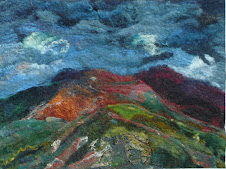
Hi thank you to both Debbie and Tracy for their helpful comments. ( In the comment section of the previous post) I have read Victoria Finley's book but a few years ago so the information must have gone in one ear as it were and out the other. (sigh) memory is evidently not as good it was and it never was very good! The idea of thickening dyes with yoghurt is a new one on me but sounds similar to John Marshals technique of using soy milk as a binder. All this is absolutely fascinating and I wish I had 48 hours in a day, as I never have all the time to experiment that I want! I am swamped with commissions and workshops at the moment. This is good but the inks have to go onto the back burner for the moment and sadly today I had to pick up my pictures from the most recent exhibition where none of them had sold. I do my pictures because I love doing them, they are inside me and burn to come out so I don't do them to sell specifically but if I don't my house will need to have extendable walls, and my bank manager might not be estatic either!
The one above is one of the unsold ones but I like it so I am quite glad to have it back. Incidentally it is unusual for me in that it has no stitch.