Showing posts with label Dye Garden. Show all posts

Wednesday, 1 September 2010

A lovely day in the Dye Garden Frogs and Solar pots

On Monday, bank holiday Monday here in the UK and the last bank holiday before Christmas , the skies cleared and the garden was full of dappled autumnal  sunshine.
We got up late. So we had Breakfast in the Dye Garden
Lythrum salicaria - purple loostrife behind
Lunch in the Dye Garden.


 Lythrum salicaria the other way outside my studio  -the original lot.  The stuff by the pond planted itself there but  I love it and so do the bees.

The Solar pots got to about 35 degrees C
and we heard a little splash and saw the Frog in our dear little pond.
 He/she  eyed us up without concern and went slowly under an overhanging ledge form where we heard a soft croak .


Many of the solar pots have ceased to develop colour much so soon I shall have an Opening and see what  is there.
And finally my little fermentation vat is going at full steam ahead! Here is some teeswater I dyed in in it  I stir it daily and add a teaspoon of washing soda if needed and it is fine.

Sunday, 11 July 2010

Bits and Pieces from the Dye Garden

Just to cheer the spirits- a view from our little pond across the grandly named patio or  terrace -really a piece of uneven paving stones to the studio.  Not many dye plants as such although the lilies are  a pleasure however in the immediate foreground is Purple Loostrife Lythrum salicaria just coming into flower, on ne of the plants high in tannin.   The pond is thronged at the moment with birds having sips of water and visiting dogs prefer the pond water to nice clean bowls of water any day.

I had been getting ready for a workshop with a lovely group of ladies known as the Fiesty Felters in Shrewsbury making and painting fine felt with extract dyes.  Here on the line are samples of the ten dyes we used.
Logwood purple, Bodfari green, , Fustic, Annatto, Madder,Pomegrante Lac.Cutch waste,Cochineal and Logwood grey.

The Silk caps were painted with all ten dyes. I didn't have time to take photos of the workshop -but it seemed to go well.  They were nice and very talented bunch who bought  a lot! Particularly my inks .  I sold all I took bar a few bottles and am now completely out of bronze and blue so will need to get going on those.  Both are complicated and take time. 
I said this was a post  was a bits and  pieces! Here are some of the  flowers I have picked to dry.
Top:marigold ( tagetes spp),  Coreopsis spp, Cosmos spp.
And finally a pot of yarrow.  The fibres were a pale yellow. I added a bit of ammonia to brighten the yellow and left it overnight and now it has gone slightly green.  I will rinse it out to day  and see what the colour is then but it looks an intriguing greeny yellow.


Saturday, 3 July 2010

Dye Garden in summer (and going down with crash!)

The Dye garden has n ever looked so good and many of the dye plants are now in flower.

Saffloweer Carthamus tinctoria just opening leaning against Hopi Red dye Amaranthus whatsit-must ask Enys for the correct Latin name as it is in none of my dye books, ( she has the one on North American Dye plants) . Behind it is Cosmos and the green is Persicaria tinctoria
Vipers Bugloss -Echium vulgare. It is a huge attractor for bees and so I managed to get one with a bee on it . This is a member of the Boriganacae family many of which give purple or blues with the roots. Someone on Natural Dyes Online mentioned a couple of years ago that they had got blue from the root. This is why we grow it ostensibly but really because Enys adores it and because it attracts bees. ( And I love it too) I haven't tried it yet. Why? Because you have to dig it up and although I always tell visitors to the garden that Enys won't let me dig it up really I couldn't bear too either. It is such a fabulous blue too.
In front the Vipers bugloss, behind Genista tinctora just opening ,with common yarrow Achilleia millifolium in full flower. You can't really see it but the Staghorn Sumach Rhus typhina is in full flower. I have never seen so many on it before and I wonder whether the flowers give any colour. Has anyone tried them?

Behind the bears is dyers chamomile Anthemis tinctoria , which is what the children will use when the BBC come to film a children's science programme in a couple of weeks. It is called Nina and the Neurones.
And the crash
A Chest infection -out of the blue not preceded by anything but an itchy cough which I put down to hay fever . So now I am on massive doses of steroids to keep my lung function from dropping to hospital admission level and antibiotics. The trouble with the steroids is that make you disinclined to sleep and to want to eat and eat and eat because you never feel full. OH woe!
Still the dye garden is lovely and DH loves doing the routine jobs like weeding and watering. And my poor student who was coming on Monday has had to pull out because of an injury to her wrist so in some ways it is all panning out. We are hoping she can rebook when she starts to recover.
I am going to have to slow down! sigh.
I keep forgetting to welcome new followers. So welcome lovely to have you all. Please do drop by and leave a note. I love getting them.

Tuesday, 8 June 2010

Work experience and the Woolfest


For the next two weeks I have Tara here for Work Experience. The idea is (I think) that Tara gets an introduction to working life as a school girl and I get the use of an extra pair of hands. Tara came to me because her mother (clever woman) brought two of my pictures and emailed asking if I might be interested in having Tara . I asked members of the Online Guild of Weavers Spinners and Dyers what they thought and they on on the whole thought it was a good idea provided I met Tara and liked her (which I did). Most butnot all of them had had a good experience of having someone for work experience.
So
Here is what we did.
I am getting ready for two days of workshop next weekend, the dye garden open to visits ( two next week) and in three weeks time I shall be having a stand at the Woolfest. There are three areas I really need to work on. Inks-I was getting down to just a few bottles. A good range of colours on the 23icron Merino. And my hand spun "Beyond the Twist Yarns". I had 24 different hanks at Wonderwool now I have ten which barely fill my yarn stand. All the knot yarns, , all the multicoloured single yarns, and all the very textured slub yarns have gone and all the Lesley Prior's Devon kid mohair and silk. This leaves me with some teeswater and silk and one of the welsh kid mohair . I am trying to spin for the Woolfest and none of the things I will get Tara to do is to drum card batts for me.
Yesterday Tara wound off 2kilos of Merino into 20hanks. and labelled them, and did the same for about a half a kilo of cashmere and silk and then we made up 5 different dye baths of complex dye mixtures to give red purples,blue purples, violet, terracotta, and reds. After lunch I started a stock check on my stock but did not get beyond the inks which were low. I sold quite a lot at the Natural Dye Day on Saturday and found I had only one green, and no purple . So I made inks and Tara stuck the labels on.
Today we will start to mordant and to get the dye baths ready. This will take up all my electric rings. In the afternoon Enys will be coming round and provided we can get into the garden we will be planting out the Japanese Indigo and the Chinese Woad But as I write this it is raining so I am hoping we will manage it.

Saturday, 20 March 2010

Spring has come to the Dye Garden


Spring has Come!

As well as crocuses miniature daffs, catkins and the fabulous delicate dwarf irises spring means other things to the dyer! Yesterday for example I was able to work in the studio without having to light my wood burner, I could hang my fibres to dry on the line and finally something , which although it has nothing to do with dyeing , excited DH and I somewhat -we have frog/toad spawn (I not sure which) in our little pond. Last night we heard the gently croaking call of an amphibian-. The little pond had been around for four or five years and over the last two we have spotted an increasing number of frogs and toad although they are very shy. Last summer when we had been away for a week they had obviously colonised the pond and I saw a frog squatting on a lily pad but sadly the pond which is in our battered flagged patio (all the flags are uneven) is probably too near the house for them to lounge around at their ease. So we are delighted to see our spawn .
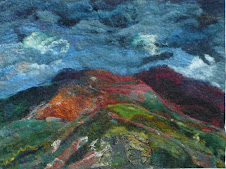
Other nice things happened. Last year my studio was open for an Open Art Studio event Helfa Gelf ( meaning Treasure Hunt) .The organisers ran a raffle, the winner having £500 to spend on art. The winner has chosen four artists who she wants to look at in more detail and she chose me as one. She came out yesterday and to have a look although she wanted either something like Tree against a Red Hill ( which you can see on my website) or a Waterfall both of which I have sold.

Then the BBC rang up to see if I was interested in a (very) cameo appearance dyeing with children on an children's programme.

On the dyeing front I am dyeing like a women possessed as I have so many workshops coming up for which I always provide all the materials in natural dyes. Increasingly in recent years I have been booked up by groups and this year I am really busy . On Monday for example I am teaching a small group of artists in mid Wales a workshop of mine called Felt beyond the Boundaries. A week today one I am running one called Felt Collars, here for the first time I will be teaching the students to felt a fine felt collar with lacey edges using the incredibly fine ultra fine 15 micron merino. Dyeing this without felting that been a challenge! Up and coming is another Felt beyond the Boundary for a group on the LLeyn Peninsular and Felt and Fabric Tote bags and Asymmetrical Bags in Gloucester both in May. In between is Wonderwool so the dye pots are constantly on the go and you can see why being able to hang stuff upon the line outside is such a relief.

The dark pink fibres on the line are cochineal extracted from the whole bugs similar to the recipe described by Leena on her fantastic blog on cochineal which you can find here. It saves the grinding but I am not sure that it gives such a bright pinky red colour as does grinding the cochineal bugs and soaking with cream of tartar. This is the method I have used in the past and comes from Trudy Von Stralen's book Indigo Madder and Marigold. I plan to grind some today but it will be Tuesday before I can dye with it

As revenge for me saying Spring has come the changeable British weather has now clamped down with a hill mist and heavy rain. Oh well at least the frogs and toads will be happy as the pond fills up.

Tuesday, 5 January 2010

DYe Garden in snow and waterfall 3


Heavy snow today, a most unusual event in this part of the world and my most recent picture Waterfall 3

Monday, 8 June 2009

Addition to the Dye Garden Ascelpius Tuberosa Butterfly MilkWeed

Posted by Helen
We have a number of additions to the Dye Garden lately, Asclepius Tuberosa or Butterfly milkweed is the latest and the one of which Enys is most proud as she has nurtured it and overwintered it and here it is in flower. This plant is a member of the Asclepiadaceae or milkweed family although it does not have a milky sap. It is a native of North America found in sandy loamy or calcerous soils of prairies and open woods and is a dye plant producing a range of yellows golds and light bright olives depending on mordant but we are also interested in it as it attracts butterflies which fill our other criteria forthe garden -that it is a garden for the wildlife. It was also used by Native Americans and early settlers for the treatmentof lung complaints-so defintely a good one for me to have- and it was at one time called pleurisy root. It was also used as analgesic, laxative, dermatological and gynacological aid
All this information about it comes from Dyes from American Native Plants A Practical Guide by Lynne Richards and Ronald J Tyrl published by Timber Press Inc ISBN 0-88192-688-X , which Enys brought back from the US a couple of years ago.

Dye Plants in Flower at the moment also include: Viper Bugloss in the picture below, supposed to give purple with roots-yet another one Imust try!


Iris Pseudocorus supposed to give black with the root but not by me


Cosmos Sulphureus flowers give yellows

Weld Reseda Luteola-this year we have had a a lotof weld but it is all self seeded and this large plant was at the edge of a a bed dug at the beginning of the growing season last year -it set a florette last year and this year has just grown and grown.This of course gives a bright lightfast acid yellow which with ammonia is almost florescent

Here is our u shaped foxglove it had fallen over got propped up again and this is the result.

and finally -the principal reason why Enys put mullein Verbascum Thapsus in the garden -it is the only place for the mullein moth, Cucullia verbasci, and here are the happy caterpillars


Jill Goodwin in a Dyers Manual says with copper sulphate this gives a good green but it is one of those plants I have yet to get round to trying.

Friday, 3 April 2009

Seeds


Posted by Helen
Last week I went round to Enys's house to have a look at the emerging dye plants mostly for the Woolfest in Cumbria in June but some will be big enough for Wonderwool Wales which is April 25th & 26th at the Royal Welsh ground at Builth Wells. The Japanese polygonum (Persicaria Tinctoria) has germinated well-over 60plants Enys said-plants like dyers chamomile (Anthemis Tinctoria ),coreopsis (Coreopis Tinctoria) and cosmos (Cosmos sulphureus) are as usual romping away, and the woads are better this year than last. One of the plants that is doing much better than ever before is safflower, carthemis tinctorius. Enys was furious at the madder -the seed tray on the top left of the picture of seed trays as none of the madder had germinated after two weeks. Over the years she has tried various ways to get it to grow, she tells me, but it is always difficult. I lent forward to inspect the reluctant seeds and saw one just starting to push it's way through. Time for champagne? I suggested hopefully. We went back to celebrate with coffee.
Incidentally the nearly flowering woad is Chinese woad (Isatis Indigotica) and as mine is flowering too we should have plenty of seeds for next year. The Chinese woad we have planted this year is still from the original seed sent to me by Annee Silk in Canada who sent them twice when the first lot did not germinate. Chinese woad (Isatis Indigotica) produces more indigotin (about twice as much)as does the European woad (Isatis Tinctoria). The comparison data is here

While I was there Enys proudly showed me lots of robust Baptisia Australis-"what dye colour do we get from it"? She asked. My mind went blank. However researching through my archives I found I wrote a post about the Baptisia and you can find what I did here!

Welcome
to my all new followers.

Friday, 20 March 2009

Dye Garden

Genista Tinctoria yellows
A quick whizz around the dye garden this afternoon showed some of the dye plants have started to flourish in the spring sunshine.
Rubia Tinctoria below giving reds, corals and oranges
Isatis Indigotica Chinese woad blues
Anthemis Tinctoria Dyers Chamomile Yellows
Solidago Canadensis Golden Rod Yellows
Reseda Luteola Weld Yellows