Showing posts with label fermented dye baths Indigotin. Show all posts

Wednesday, 1 September 2010

A lovely day in the Dye Garden Frogs and Solar pots

On Monday, bank holiday Monday here in the UK and the last bank holiday before Christmas , the skies cleared and the garden was full of dappled autumnal  sunshine.
We got up late. So we had Breakfast in the Dye Garden
Lythrum salicaria - purple loostrife behind
Lunch in the Dye Garden.


 Lythrum salicaria the other way outside my studio  -the original lot.  The stuff by the pond planted itself there but  I love it and so do the bees.

The Solar pots got to about 35 degrees C
and we heard a little splash and saw the Frog in our dear little pond.
 He/she  eyed us up without concern and went slowly under an overhanging ledge form where we heard a soft croak .


Many of the solar pots have ceased to develop colour much so soon I shall have an Opening and see what  is there.
And finally my little fermentation vat is going at full steam ahead! Here is some teeswater I dyed in in it  I stir it daily and add a teaspoon of washing soda if needed and it is fine.

Friday, 27 August 2010

fermented indigo vat

Madder/Bran Fermentation vat ]
I started this on Tuesday night. as  I want it for my Dyeing the Blues Workshop on Saturday.
Recipe
The recipe calls for 9 litres of water but I filled up a small stainless steel pot- I think it might be 6litres
60g madder
30g bran
500ml of wood ash lye at pH 14. ( This is the last of my oak ash lye). I put this as even though  in proportion it might be too much but somehow I thought it would be okay. and as it turned out the final pH of the solution  was 9 verging on 10 which was fine and in fact the one important and critical measurement (along with the temperature)

25g of  finely ground indigo.stirred with hot water to a paste. The recipe called for 22g but I had a packet of 25 g so what the hell! It all went in. Would 3g really make a difference?

I boiled the madder  and bran , wood ash lye ,and water for twenty minutes,  allowed it to cool to 40 degrees C before adding the indigo paste, covered  and placed on the heating pad to keep warm. pH was 9. Incidentally a scientifically minded friend though the boiling was to get rid of the alizarin in madder. Certainly the froth  goes a fabulous purple or dark red colour.(I have had both colours). On this occasion it was more a dark red.
Wednesday am. The vat was 38 degrees, a  few bubbles on the surface. pH 9. Stirred . The vat is starting to smell that characteristic slightly sweet smell
Wednesday pm The vat was 42 degrees pH had dropped to 6.  I added 2 tablespoons of sodium carbonate ( washing soda). The pH drops because of the lactic acid produced by fermentation and at this stage you need to check the vat twice a day as pH can drop rapidly as you can see.  If the vat becomes acid the vat is described as going sour and the indigotin is lost.Vat smelling
Thursday am The vat was pH 7 I stirred added 2 tablespoons of washing soda, stirred and checked again. pH was now 9.
Thursday pm about 5.  The vat had dropped to about pH8 and was nicely warm at 42 degrees C.
I checked it again at 7 ish and it had dropped to Ph 6-7 so I stirred , and added 2 tablespoons of washing soda.  I used to make a solution and indeed used to use wood ash lye but this either means adding cold liquid  which cooled the vat down or heating it up and now I find adding washing soda works fine.  If in doubt as to howmuch to add  add a little like a teaspoon , stir and check the pH.
Friday am
Ph7-8  37 degrees C!-it seems to have been really cold overnight as the studio felt really cold this morning to the extent tha\t I discussed with DH lighting the wood burner to take off the chill.
I stirred, added 1 tablespoon of washing soda  to pH 9.
The vat had an indigo sheen this morning as well as a slight froth and the sweet fermented smell . I added some newly washed teeswater ( about 25g) down the side of the vat. At first  I  thought they went an olive green then perhaps a more yellowy colour.  Anyway I have left them in till this evening or possibly till tomorrow when the workshop starts.
Friday pm 
pH 7-8
 Stirred added 1 tablespoon of washing soda. Forgot to takethe temperature.

I have changed the title of my blog- this morning it seemed funny tonight feeling down it seemed offensive. .
I have lost a follower I  wonder why?

Madder bran vat day 3.5  sheen of indigo flower on surface 

Rather surprisingly the fibres have quite a green cast.  Was it the teeswater being a bit discoloured? I don't know.
very gradually the fibres turned a darker green but not really a blue.
Saturday 
Vat was 35 degrees C PH was 8, so Iadded a tablspoonof washing soda to bring it up to 9 and the little vat dyed all the day coping with 6 students putting two lots of stuff in each. A lot of the fibres still had this strange green cast and my other thought was that there was some yellow dye in the pan left after dyeing  otherwise I really cannot account for it.  In the evening I just  stirred it and left it.
 A tidy studio ready for 6 students!
 
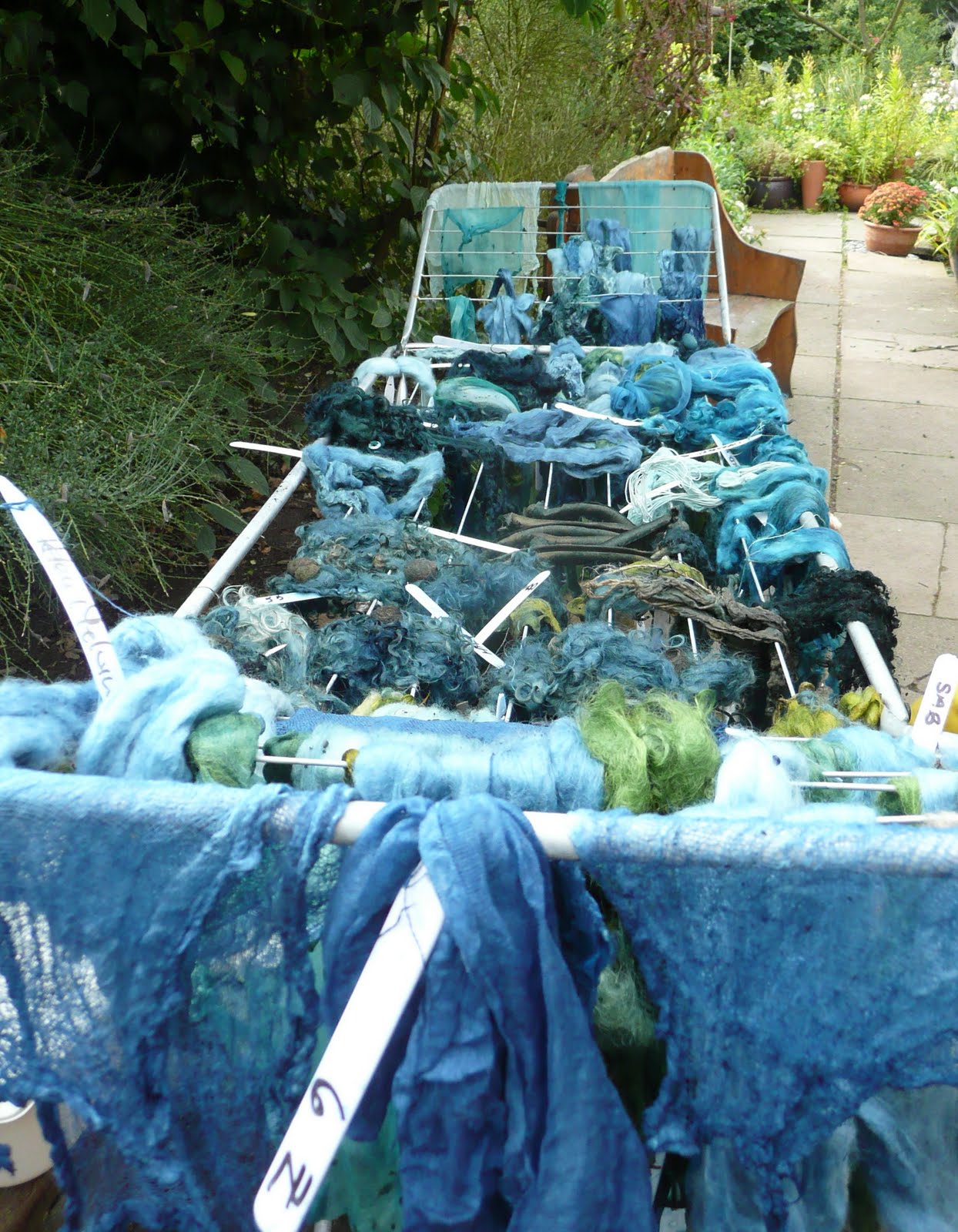
The Blue Table

 The results on the airer. The students  had 100 g of merino, half a silk cap, some silk chiffon,  and could pick from teeswater, silk cocoons, carrier rods.and some  yellow merino dyed with Gensita Tinctoria as as well as  dyed teeswater.  I think everyone had to work quite hard but they all dyed everything in their packs and some managed repeated dips for a darker blue

 On the Dyeing the Blues Day. We dyed with fresh woad leaves, fresh Persicaria Tinctoria for blue and in acidulated  water for turquoise-hanging at the further end of the airer.  We made up a Chemical reduction vat and the students were able to use a fermented vat.  The woad was  better than  I thought but the persicara-grown in Enys's greenhouse - was superb.  We did not have time to use the persicaria vat made form my home grown leaves so I am going to use  that this morning.
Sunday
Much to my surprise  this morning the fermented vat had bubbles on the surface and the pH was 9 Temperature was 36 C.

Monday, 14 December 2009

Allergies

I have just been to see the doctor with a face that you don't want to see! This morning my eyes were so swollen I could only just see and my face looks at if it is on fire. The culprit? We think the initial reaction was when I mopped up some spilt wheat bran in my studio as I did so the skin on my face started to prickle and irritate. This was then followed the next day by a response by my skin to my shampoo. I have known for about ten years that I am allergic to the thickener that is in nearly all shampoos but haven't had massive problems however evidently this time it was a challenge too far and I had a serious reaction. At least I think that is what it is. I shall have to get Dh to remove all the wheat bran from my studio and bang goes one of my favourite fermented indigo vat -the madder bran vat.

Saturday, 26 September 2009

Fermented Indigo Vat


I have had a fermented indigo vat on the go now for over a month. I set it up for a Dyeing the Blues workshop in my studio at the end of August and it has been going ever since and students at my most recent Dyeing the Blues on the 24th of September were able use it. My visitors coming to visit over the past two weekends of the Helfa Gelf Open Art Studio event have been intrigued by it and a few have braved the label of "rather smelly" and asked for a demo. One male visitor who was studying, he told me, for a diploma in archaeology, lifted the lid to have a sniff presumably to get an authentic whiff of the past! I tell people that dyeing with indigotin (the proper name for the indigo blues ) is ancient, widespread and that for thousands of years this is how people have got blue and they are mostly fascinated.

This particular vat has been superb. It is a madder bran vat using woad ash lye-a 17th century recipe I originally got from Sandberg*. wood ash lye is easily made by filling a bucket with wood ash and topping up with water. After a couple of the weeks the clear water at he tops is a mixture of potassium carbonate and potassium hydroxide . During my reading for research for my indigo book (The Colour of the Sea and Sky, The Art of Indigo Dyeing) I found references to different types of woodash. It was said that woodash from oak made the best lye for fermentation vats and after that hardwoods. A local woodworker working in oak burnt all his scraps for me and made an oak ash from which I made a lye.This vat is made from that and whether for that reason or not has been superb.

The vat sits on a hotplate originally used for wine making which keeps the vat warm at between 35-to 40-degrees. Fermentation vats do like to be kept warm. The madder and the bran ferment and as they do so they use up all the oxygen in the water. At the start the wood ash lye made the vat alkaline with a pH of about 10. As fermentation proceeds it creates lactic acid and this makes the pH drop so every morning I stir the vat, check the pH adding washing soda if it has dropped . When the vat has no oxygen in and is alkaline the insoluble indigotin converts to its soluble form when it will bond to the fibres. Removing the fibres from the vat results in the oxygen in the air converting the soluble form back into the insoluble indigotin which is bonded to the fibres.

Every now and again ( such as once a week) I drop in an handful of madder and of bran and three times in the last month 10g of indigotin mixed with hot water to a paste.

The million dollar question is -why do I like the fermentation vat so much? The answer is it is so easy to use. You just put something and leave it -overnight more often then not. Oxidise and then put it back for a couple of hours for the deeper blues and you can see from the photo how dark some of my blues are. These are much more difficult to get with the modern chemical vat which has to be carefully balanced to make sure that indigotin is not stripped off as a fast as it is deposited. I also like the sense of being connected to thousands of years of history

Madder and Bran Vat

This vat has the advantage of being least smelly of the fermented vats and comes from a seventeenth century recipe. You will need:

  • 9 litres water

  • 60g madder

  • 20g bran

  • 22g indigo made to a paste

  • 500ml of wood ash lye

Put water, madder, and bran in a pan, with the wood ash lye and heat to boiling. Boil for 15 minutes. The scum on the surface will turn pink then a rather gorgeous purple. Allow to cool to 40°C and then add the indigo paste. Maintain this temperature and stir daily.

At 40 degrees C this vat will come into order within two days but the pH will drop rapidly. Add a tablespoon of washing soda on the second day or if you see that fermentation is rapid with lots of little bubbles on the surface, and stir well. As it comes into order you will see a patina of indigo on the surface like a coppery blue sheen. The characteristic slightly murky green liquid underneath may be slightly masked by colour from the madder but experiment by dipping some fibres leave for half an hour and remove. You should then see the yellowy green colour on the fibres.


J.N. Liles The Art and Craft of Natural Dyeing: Traditional Recipes for Modern Use University of Tennessee Press ISBN 0-87049-0

Gosta Sandberg Indigo Textiles Technique and History Lark Books ISB9372274


You are most welcome to use this information on this blog for your own personal use but it is copyright Helen Melvin and the information is not to be used for commercial gain.

Ps I am still carrying on with some shibori (see previous post)