Showing posts with label natural dye inks. Show all posts

Thursday, 1 July 2010

Update


I am coming to after a hectic time. First we had ITV Wales filming the garden as part of National Garden Open in Wales. For those of you not from the UK this is a uniquely British event where people open their gardens sometimes just for one day sometimes for groups visiting . All the gardens are listed in a famous yellow book. The visitors fee goes to Charity. Most of the gardens are absolutely stunning and often very grand stately homes but also little tiny cottage gardens too. My parents were very fond of visiting gardens and when my father moved up here he and I went round gardens together although mostly I think because my father was very partial to the home made cakes that so often feature! Quite where I found the courage to propose the dye garden to the organisers I don't know. I think it came from the day when we opened the garden last year as "Shopping for Colour" and it was so obviously enjoyed. Someone said to me you should open under the National Garden Open Scheme and here we are. We are open to groups visiting when Enys and I talk about the plants and I talk about dyeing and then conduct them around the garden. The solar pots have been a very good way to introduce people to the colour of the garden especially the madder , birch and golden rod pots.
So last week -was it really only last week?- ITV filmed. I forgot to ask Enys to take pictures of me demonstrating woad dyeing and I only took a few of her but it gives you the flavour of the day. We both enjoyed it it very much and it was a fascinating experience. I picked woad leaves six or seven times while they filmed it from different angles-amazing that the woad leaves held up. I kept finding another little plant hiding under something else as it has self seeded around the dye beds.
Two days after that we loaded the car, squeezing an unhappy dog into one tiny corner and set off for Woolfest. "Don't buy anything will you" said DH "there is no room even in the top box". Not buy anything! Go to the Woolfest and not buy anything. The poor man obviously had sun stroke. Fortunately a good friend with an empty car came to the rescue and took back my two fleeces and a swift and I sold some big bulky items such as all my new solar pot kits complete with 2 litre Kilner Jars which took up a lot of space. We could have sold these twice over they were all gone by 10.am of the second day. Another great success of the Woolfest was my inks of which I sold a lot. These inks designed by me for painting and writing turnout to be excellent fabric paints too. I painted some pre-mordanted silk with them steamed and rinsed. No colour came out at all

In between ITV filming and setting off for the Woolfest my new Aura wheel, the fantastic new spinning wheel from Majacraft, which had arrived but was sitting tantalisingly in it's box was set up. My original vision was that I would sit spinning some fantastic textured yarn at Woolfest to advertise both my fibres, my packs and my new Beyond the Twist Yarns. A good friend ( I am very lucky in my friends) recovering from a hip replacement carded me some batts to spin and some batts to sell. Did I get a chance to spin? Well I expect you are smiling as you read this . Of course not- except for a few minutes here and there. Plus the fact that people bought the batts which were meant me to spin so at the end I had no batts at all! The wheel attracted a a lot of interest. I directed them all to poor Martin of PM Woolcraft who imports them and from whom I bought mine. I say poor because none of his ordered wheels had arrived. I was very fortunate to have mine as it is at the moment one of only three in the UK. What is so good about it? Well it spins like a dream. The huge flyer and fantastic threading system (no hook pulling the yarn through a tiny orifice) means it will spin from laceweight to bulky yarn. A hugely versatile tensioning system with two different tensions means it is very flexible. In the picture you can see some fine yarns ( some of my cashmere and silk plied with a laceweight merino) and an over the top yarn with teeswater curls spun in whole.
What am I doing now?Getting ready for the student coming on Monday for two days. Which means tidying up my studio. Sigh! (And I still have not fully unpacked the car)

Tuesday, 2 December 2008

Two New Blogs for Natural Dye enthusiasts

Posted by Helen
Hi every body I am back from Jersey which I will blog about later but this is just to tell you that there is a new natural Dye blog, Jenny Dean's wild colour, on the blogging scene. Jenny Dean is the author of a number of dye books including Wild Colour and produced one of the first books The Craft of Natural Dyes (I think - I can 't find my copy at the moment so that bit is from memory) which focused on environmentally responsible dyeing. Jenny is also very knowledgeable about dye plants. I also took a very enjoyable and interesting natural dyeing workshop with her years ago which I can still remember and for which I still have my samples.

While I was away in Jersey and with a bit free time on my hands I started a new blog. This is Natural Dye Inks and I hope that as well as my paintings in natural dyes that all those who has brought the inks from me will also post up their pictures too.

Welcome to two new followers who pooped up while I was away, Madeline and Fibre Fanatic.

Tuesday, 18 November 2008

New Natural Dye Inks: blue and bronze

Posted by Helen
Welcome to some new followers of my blog Yvette, Willington Weaver( Hi Alison) Mollys and Martine.


I have been busy making new ink colours. The inks have been a bit quiet or rather the sales of them have been quiet but have suddenly started to pick up. Every time I ran a workshop someone would buy a set of 5 or 8 and people have been coming back for more and like ripples in the pool they have been getting to a wider audience. Two local artists , amongst others, have been using them; David Brightmore and Jan Gardner. It was David who started me off on the journey of actually making inks rather than concentrated dye baths, which I had been using and tells me that he has sold some of his pictures painted with my inks and he has also been back for more.
Last week Debbie Bamford went off to the original reenactors market at Coventry taking with her my medieval inks; a medieval black, yellow and red, the black and the red being new. She sold a few and says that there was a lot of interest, but it takes time for people to buy something new: it is seems so odd to hear my medieval inks described as something new as the very name makes them sound antique and you would expect re-enactors to leap on them with cries of joy, especially as Debbie sells quill pens, but apparently not, apart from a discerning few. In the meantime having a few days free between the end of one set of workshops and the next series in Jersey I decided to bite the bullet, gird my loins and face the challenge of blue. The reason for the girding of the loins part is that I thought the only way to make a good blue was by going via saxon blue. Saxon blue is in fact indigo sulphonate which is indigo dissolved in concentrated sulphuric acid. I was a bit concerned about using this as my memories of A level Chemistry were rather in a dim and distant past , but one of the people who came to my last workshop on mitten making is Pam who teaches Chemistry . She went through safety procedures with me so on Sunday I made some indigo sulphonate wearing goggles, face mask, vinyl gloves and old clothes., stirring finely ground natural indigo slowly and carefully into a measured lot of concentrated sulphuric acid. It had to be left for two days but today it was ready for use so I experimented with making it up into an ink and here is the result.


The first is a weak concentration and the second a higher concentration . The texture on the surface is the paper's (I think) which is a heavy weight rough textured paper 425not- i.e paper that has not been either hot or cold pressed to give a smooth surface. However I was a little concerned about the look of that ink so when I made up the full amount I made sure that the thickener was very well dissolved and smooth.


My next ink is a bronze. I have long been wanting a bronze. The recipe I have for bronze ,which I found in Dominique Cardon's book Natural Dyes, and which apparently was designed for the Marquis de Pompadour, the husband of the courtesan Madame de Pompadour mistress to Louis XVth. The recipe was for brazilwood and weld and I used a variation of it for the fibres for the felt bronze bell which I made with the children of Bodfari school. I was really pleased with the colour . I have been trying to replicate this in ink but it had not worked but after a lot of experimenting using a combination of three dyes I made a bronze I liked. I am not going to say exactly what the dyes are -a girl's got to have some secrets- and after all I do sell them, but above you can see the result . The painting in the blue and bronze is a sheet of watercolour paper destined to make five covers for my dye books which continue to sell steadily. One of the things I really liked is the interaction the blue and the bronze, sometimes it went a very gorgeous green , but a tiny bit of blue on the brush made the bronze go into different bronze colours. Quite yummy in fact!


I noticed that India Flint describes herself as a mark maker which description I like very much and wished I had thought of-sigh- It occurred to me that what I do when I make my dye book covers is not painting but making marks and above is another also in bronze and blue but using different brushes and marks. Finally I have put in one of my pictures- a design for felt which never happened as when I tried to translate it into felt it did not work, but I like the painting.

Saturday, 19 July 2008

Natural Dye Inks


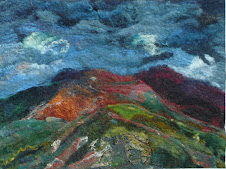
My new Natural Dye Inks which I have been developing over the last six months are now on my website for sale. These are the inks I now use for painting the covers of my dye books and also for painting the pictures that are the start of the process for creating a new landscape in naturally dyed felt, and machine stitch.

As I view the photographs above I feel frustrated as despite my best endeavours they do not show the richness and complexities of these beautiful colours.

Thursday, 24 April 2008

Ink! Ink! Glorious Ink!


I am off to WonderwoolWales tommorrow with my stall . And! .............With my Inks!........................

I am so pleased with my dear little bottles so here is a photo of them all.
Brazilwood soft red- a traditional recipe,
18th Century Black
and the rest I invented myself.
Cochineal red
Green
Yellow
Turquoise.
They are £6.50 each for 50ml or special offer buy four get one free! They will be on my website soon as soon as I manage to work out how to post them. In the meantime I shall be at http://www.wonderwoolwales.co.uk/ with them but although they have been ready only for one day I ahve already had an order for four !
It has been a very interesting journey which is not over yet as when I started to look into inks I was just interested. The decision to try making some for sale developed as I went along.

Sunday, 13 April 2008

Fun with inks and plants for Wonderwool


Hi! This weekend I have been recovering from teaching 59 children from 3 - 11 to dye yarn multicoloured, to make pencil cases which they then dyed in a woad vat ( the week having a Celtic theme) all that is except for the 3-5 year olds who made smiling faces in felt and naturally dyed merino tops. It was great fun but I have been knackered so yesterday I did nothing except walk the dogs and today I indulged myself playing with the new Natural Dye Inks. I painted three sheets of watercolour card ready for my new series of Colours of the Earth as I am now down to the last four and I have edition 2 ready and waiting to be printed. I really enjoyed painting with the inks, they flow smoothly except my green is a bit watery which I will have to rectify and they are also clear and bright. Today I played around with mixing some of them particularly the grey and yellows for a limey green and also the reds and yellows. I am hoping to have the new edition of the dyebook ready for Wonderwool. http://www.wonderwoolwales.co.uk/ and also some of my new inks which visitors to the stall will have a chance to play with. So if you are in the vincinity come along to Wonderwool which incidentally is on the 26th 27th of April at the Royal Welsh Show Ground · Llanelwedd · Builth Wells · Powys Event Opening Times: 10.00am - 5.30pm
Enys rang me up and said she will have quite a few dye plants to bring including; Woad, Isatis Tinctoria. Japanese Polygonum,Polygonum Tinctorium, a few Madder Rubia Tinctoria, a few Weld, Reseda Luteola, and Vipers Bugloss, Echium Vulgare ,which we will grow as a dye plant for the first time this year as it is is a member of the Boraginaceae which is the same group as alkanet (Alkanna Tinctoria) and has been said to give purple with the root by some of the members of Natural Dyes Online
Bye for now!

Wednesday, 2 April 2008

Inks from Natural Dyes


Those of you who have been following my blog will know that I have been playing around with making natural dye inks ever since a local artist David Brightmore http://www.davidbrightmore.com/ asked me to make him a set of inks from natural dyes a few months ago. I have had the inks on the back of my mind for a fow weeks and earlier on this week made space to make some of the traditonal recipes. I first made two "blacks" the first the traditional gall nut ink the second a later in time ( 1800's) slightly more complex one with logwood, and sugar. Then I embarked on the brazilwood reds the traditional source of most red inks up until the the 1920's. I made two the second of which I used in the pictures are with the brazilwood extracted in acetic acid. This latter recipe I found on the net in Henrietta's Herbal Page http://www.henriettesherbal.com/ .
the blacks from David Carvahlo's book 40 centuries of ink. published by http://www.echo-library.com/ ISBN 1.406844136. Browsing through Dominique Cardons Book Natural Dyes I came across a reference to fermented persian berries being used to make a green paint and then felt that I really wanted to make a set of dyes quickly having got into the swing of it, and not wait around for a week or so to ferment the berries so I made up a concentrated solution of the extract of rhammus berries and made an ink with that. That is the yellow. I have been playing around with making paints, it is these that I use to paint the covers of my dye books, for years but had not found a good strong yellow to paint with except saffron. So I was extremely pleased to find that the persian berry extracts made a really strong yellow. The final colour the green is made with an extract called "green" surprisingly enough and this is apparently extracts from various plants. This I also made up into a a strong solution and made an ink from that. Then I painted a picture! I am pleased with them with some reservation. I had hoped that the brazilwood would be redder and the black is really a charcoal grey,nice to use in a paint but not quite dark enough for writing. However I have got the hang of making inks and for my own purposes ,which is to paint pictures as a starting point for my felt landscapes , I am more than happy with them and think I will try the cochineal red apparently more brilliant but less lightfast and purple. I have put samples of ink painted onto card in my southwest facing window for a month so will see how these fare lightwise.
Oh! and the blue on the right hand side is not an ink but a thickened ( with gum tragacanth) indigo concentrate.

Sunday, 10 February 2008

Gallnut ink


I am in the process of making a gallotannic ink. On the left are 50g of gall nuts about 10 years old -at least- I have had them on my shelf for least six years and my friend Anne Campbell , who taught me to spin, gave them to me and she had had them for a while.
I rolled them up in a tea towel and bashed them with a rolling pin till they were crushed this took about a couple of minutes. ( top right)
Then I put them into soak. Jenny Dean in Wild Colours says to leave them in soak till they become soft. At first they floated on the surface, it is only now only two days later that they have begun to sink and they are still hard.The water has become a dark brown.
More later!

Monday, 4 February 2008

Inks from natural dyes

I feel quite nervous about putting up my findings from reading about inks. Partly because I feel that some real expert will pop up and tell me I should have done my research more thoroughly. This is no doubt because I took The Materials and Techniques of Medieval Paintings by Daniel V Thompson on holiday and read it beside the pool making rough notes form which thse notes come.
Well here goes:
As I am interested in creating inks which are brightly coloured indeed intense I have tended to go for the inks used in medieval manuscript painting as these appear to have been the brightest most intense colour.

Daniel Thompson feels that colour could be applied to parchment ( made form skin), to wooden panels or to walls. By and large the colour that could be used to apply to parchment was described as ink as it could flow through a nib or be painted with a fine brush. However the issue of light fastness does come into play. Dyes used as inks in manuscripts did not have to be so lightfast as dyes used on panels or on fresco's.
Ink comes from "incaustum" meaning burnt in.
Lampsoot Ink The ink of Antiquity
A Suspension of Carbon
The oldest form of ink, known to Egyptians, was soot, water and gum. Lampsoot was valued because the particle size was very small so required no further grinding and was made by letting a flame play on a cold surface. The Chinese however developed lampsoot ink to a very high standard and an artform too using lampsoot, water and gum and various other ingredients to help it run smoothly and smell nice. It took long beating and was designed for brushing and painting on the very absorbent surfaces of handmade paper. The art side of it happened in as Chinese ink was dried and compressed and set in wood moulds with carved pictures.

Lampblack and gum does not bite into surfaces as does gall ink but sits on the surface and if the gum becomes brittle or has not been prepared properly then the writing disappears.

In the medieval age carbons were made from charcoal from young shoots of grape vine, but others such as peach stones were highly favoured.

Black Gall0 -Tannic inks
These are the suspension of black organic salts of iron mixed with other salts which become black after use.
Oak trees form galls or gallnuts as a result of a sting of an insect and thse galls are full of tannic and gallic acid which Daniel Thompson says can be soaked out of the galls. Jenny Dean in Wild Colour, say to crush, soak until they are soft and then to simmered for an hour to extract the tannin. When these acids are mixed with iron salts such as ferrous sulphate ( rust) a purply black ink results.
Modern techniques are so good that the black is not visible because of the purity of the ingredients, but in medieval times some black colour was produced otherwise the black appears on oxidation and improves with time. Some gum arabic is usually added to thicken and to improve the flow.
Well that is all I have time for tonight .

Friday, 11 January 2008

Paint or Ink, & Chinese ink

I had wondered whether what I made with my concentrated dyes were inks or paints. The suggestion from various members of Natural Dyes Online was that it depended on whether you used brushes or a pen.

below is quote from a paper on Chinese Ink I found interesting.
" Typical artist's colorants are either dyes which form a true solution or may be precipitated onto an inorganic phase to form a lake, or large sized pigments mixed with a vehicle to create paint. In contrast the nano sized carbon primary components of Chinese Ink 10-150nm carbon soot particles, make it a colloidal dispersion or sol ( aqueous dispersion)" (Characterization of Chinese ink in size and surface Joseph R.Swider, Vincent A. Hackley. John Winter Journal of Cultural Heritage 4 (2003) 175-186)

I have really enjoyed the bit of reading about Chinese ink, which is basically soot mostly from wood soot usually pine wood soot,and glue but as the article pointed out the Chinese developed this type of ink into a very sophisticated form which being carbon based is not prone to fading and sticks well to the paper or in earlier times wood. Sometime after discovering wood soot lamp soot which made finer particles of carbon was found to make the very best inks. Apparently the soot and glue had to be pounded 5000 times and I immediately had a vision of some poor apprentice, arms aching, pounding away to make the ink. The glue -made from animal hide- is hugely important. Without it soot does not work as ink and the glue acts as a dispersing agent so the ink flows smoothly and as a binder to fix the ink. There was also some evidence that it stopped fungal growth too. The article did not describe how to make the ink and I shall have to look elsewhere for that but as the ink got more sophisticated more ingredients were added some to disguise the smell and some to improve colour such as indigo I was interested to read. One final point is that Chinese ink when mixed is a paste which is set in wooden moulds , so as time went on making these ink blocks became an art form. The ink block had to be rubbed on an ink stone to create the ink.

All this information will no doubt sound quite basic to anyone with any knowledge of inks but it is new to me so I found it quite fascinating and it has been a help summarising my reading if only very briefly.

On another note David Brightmore whose casual comment started me off on the journey into the world of inks came to see me and my studio today and left clutching my inks for a bit for experimenting . Now that could be really interesting!

Thursday, 10 January 2008

Fibres for spinning and a little on inks


Over the last year my spinning wheel has been calling plaintively to me from a corner of my sitting room. Every now and again I dusted it and wondered if I would ever get back to spinning. You have to understand 1. I don't knit ,can't knit 2. I don't weave- hence my love for crochet and only free form crochet. This is because I cannot be creative and count! 3. I am an evening spinner. Until last January my evenings were not really free as I looked after my dearly beloved father and he was usually here till 9pm then somehow I could not get my head round it and then I found ( and this shows how long it is since I spun) my lendrums's string for the single drive band bit had perished which I might add caused me to go into total panic mode but fortunately I was rescued by Martin of PM Woolcraft.
This Christmas DS's firmly plonked the TV into our sitting room, and suddenly here we are back to DH watching TV a little and me watching along with him and spinning! What am I spinning? A Shetland /Ryeland cross that my dear friend Anne persuaded me to buy. I have been washing and dyeing it throughout this winter with I might add the intention of making up packs of it for the wool festival Wonderwool. I gave some to Anne -mistress spinner- to sample and loved the resulting textured yarn so much I decided to do some too! ( quite different from Leigh's ( Leigh's fibre Journall) beautifully spun Shetland !)Plus I love love love the colour I have dyed it. It has been multidyed with extract dyes. Green from Living Colour and logwood purple, logwood grey from Earthues. Then I had a mad moment and ordered some bowmont from Lesley Prior. What am I thinking of I need a new project like a hole in the head.
This alongside the rapidly expanding project looking at natural dye inks!, My now fully booked workshop next week Leaves of Gossamer Felt ( and I have all the packs to do) a commission to dye 1.5kilos of merino tops for medieval felt maker Rachel Frost, a commission to make a bag ( for which I need to dye the fibres. ) Quite mad!
On the Inks. I now have the Artists materials that Dorothy of Dot's fibres to Fabrics recommended in a previous post. I am waiting for a book on medievallpaints and a few people directed me to Forty Centuries of Ink by David Carvalho which I have now ordered too. In the meantime the subject has inspired Natural Dyes Online and Ruth Schooley has kindly sent me a couple of papers on Chinese ink which I started reading today.
One of the interesting comments that came out of Natural Dyes Online is that whether something is ink or paint depends on what one does ie writes or paints. Although the more I think about this the more I think that this is not quite right still maybe my reading will illuminate this. I can't help thinking that inks are fluids and paints originally solid at least in the West.
The other I like is that apparently cornflowers were used to make a blue ink so I will need to grow some cornflowers.
It's getting late so off to bed.

Wednesday, 2 January 2008

More on inks and dragon's blood


I have now had a chance to play with the "inks" which have been thickened with gum arabic.
The colours are a little more muted than before and I think slightly dulled which is what Michelle Wipplinger in her booklet on dyeing with the extract dyes says happens with gum arabic but the consistency is different from dyes thickened with gum tragacanth which is what I use for printing and stencilling. I had a friend with me and we spent the afternoon playing with the inks and she found it disppointing that the inks did not move and blend in in the same way as unthickened ones. I quite like the fact the dyes stayed more where they were put instead of flowing into one another! Here is my study of a decaying leaf-part of a series for a wallhanging in gossamer felt of floating leaves. The quite bright orange was a cheat! I made it up by dissolving 1/4tsp of annatto extract in 50ml of hot water.

So first of all I need to make up the gum arabic properly - jsut dissolving it in hot water not heating it. Then I think I need to make more intense colours both the saffron,and the logwood were disappointing and I think Imight have a bash at making a red as the cochineal and tin still went more to the pink so mixing cochineal and madder possibly. Although on it's own madder makes a disppointing paint givng a dull pink

I have now got one of the books recomnended by Dorothy- The Artist's Handbook of Materials and Techniques by Ralph Mayer. This book came very quickly via Abe books the other one on medieval inks has not yet even been acknowedged by the seller which is rather annoying. So I am busy reading and making notes. Sometimes I wonder whether I have bitten off more than I can chew but this is probably becuase I am suffering my third illness in two weeks - this time a nasty cold.

Dragon's Blood.
This one really intrigued me. I was reading up on Mediera as DH and I are going there for a holiday shortly, and it was mentioned that before Mediera was settled by the Portuguese, sailors used to visit the Island for a dye known as a dragon's blood which was a tree resin. I turned to Cardon, the only mention of it here was in passing as part of an old recipe for pink and she called it dracaena cinnabari (balf) but John and Margaret Cannon in Dye Plants and Dyeing said that dragons blood was the resin from sanderswood. It might be nice to know more but I am not sure where else to look. It would be fun to get some dye when I am on holiday, but it is unlikely I thinks as apparently the land was extensively cleared.

Saturday, 29 December 2007

Inks, post Christmas blues and watching the Titanic


Both the DS's have gone back to normal life one to job and v.busy social life, and the other to finish his PH.D. DH has gone off to work so as soon as I could I went to investigate the "inks" I had made before Christmas. I had put a tablespoon of dye chips, except for the saffron which was 1g , added 100ml of water and put them into jam jars in the slow cooker which were making dyebaths for 48 hours or so. Then I filtered them through coffee filter papers into glass spice jars and left them till today.
Left Column top to bottom. Saffron, Cutch, Walnut with iron added, logwood with iron added ( surprising! and I have now added some washing soda to get purple).
Right Column. Cochineal with tin added after filtering & ammonia. Cochineal with iron & ammonia, Black oak -disappointing as an "ink" ,Cochineal with tin added at the soaking stage.
You can see from these samples how watery and runny the " inks/paints" ( I am not sure what to call them!) are so I thought that I would try and see what "stabalising" with gum arabic means. ( see previous post)
I hunted out some old dusty gum arabic and tried to find a reference in my dye books to using it. I am sure Liles has it in but could I find my Liles? Could I heck. In the process I found I have no less than two copies of Bemiss! Who is not a lot of use in this case. Nor were my other dye books although I must confess my search was a bit cursory. There was nothing in Cardon, nor in Jenny Dean's, nor in Susan Bosence books for example although I am sure I have seen a recipe somewhere.
I tried dissolving a few lumps of gum arabic in water in my studio microwave , but in the end heated them, stirring in a small pan till no more would dissolve and then added the resulting solution to my "inks". It did not make much difference and in the end I added in the order of 1 tablespoon of gum arabic solution to 50ml of " ink". I was planning to go back after I had eaten but succumbed to the temptation of watching The Titanic sink on BBC2-why I cannot think as it is a lousy film apart form the sinking bit which is quite dramatic so I put it down to being still post bug as as my legs still feel a bit jelly like it will have to do as an a excuse. So I will have to wait till tommorow to see whether I think there is any improvement . I have painted with dye thickened with gum tragacanth which makes a sort of textured paint so it will be interesting to see the difference between the different types of thickener.

Wednesday, 26 December 2007

Medieval Inks, buckthorn bark and being laid low with a nasty bug.

This is just a quickie as I have been laid low before and after Christmas with a horrible bug. Fortunately I was okay over Christmas itself but a new bug laid me low this morning. At least I will not be putting on weight this Christmas.

I have been doing a little research into inks and find that they are stabalised with gum arabic but so far there has been surprisngly little information in my dye books and I have had more luck researching online. So far I have only come across the standard walnut ink, brazilwood, iron and vinegar and a comment that greens and blues were made but that they were difficult.

Making Woodash
A few weeks ago I put about three to four inches of woodash lye into a bucket and filled it up to the top and produced a weak woodash with a pH of about 9 . That this was not enough is evident because I put 200 go buckthorn bark into a pan covered with the weak wood ash lye and left it on my heating Pad ( ones that are used for wine-these are flat pads which get warm). When I briefly checked on Christmas morning it was covered with mould and the pH was neutral at 7. Fortunately we have had a lot of very cold days and have had a lot of woodfires so I was able to fill a bucket three quarters full of woodash and this is now producing a wood ash lye with a pH of 12. I suspect that I will have to restart fermenting the buckthorn bark so I have lost a week. Very annoying as I am dyeing merino 100's for my next workshop.