Showing posts with label solar dyeing. Show all posts

Monday, 18 July 2011

Woolfest 11 the best ever. Solar pots and afterwards


This years Woolfest  at the end of June in Cockermouth Cumbria was the best ever both personally for me and I gather for the Woolfest itself with 5000 visitors .  On Friday they had  500 more than last year a truly impressive achievement I think.  ]
The Demo area next to my stallPhoto by Peter Davies

This was the first year I demonstrated and I had one of  the new official demonstration stalls-I scheduled for  3 demos  each day exhausting but worth it . FRiday was Solar Dyeing , Wild Carding and Natural Dye Inks, Saturday was Solar dyeing, Art Yarns and the Fructose and Lime vat.  I was helped by Anne Campbell who taught me to spin and who stepped in and demonstrated the Art Yarns on Saturday which was a not only  a huge help but actually she is better than I am anyway. ! All the Demonstrations were very popular but the one that drew the greatest interest were the Solar dyeing  Demos which I did on both days and on the back of those I  sold out of my new book Colours of the World Eco Dyeing and all my solar kits and I am still filling orders for these.  The stall was packed and I even had people peering over the side of the stall-they must have been standing on something  and I got a spontaneous round of applause. I loved it.
 
We finished setting up at 7.30 on the Friday   having started at 3pm and after the 4 hour drive were fairly exhausted so shot down into Cockermouth and were very pleased to find  the Tarantella open  again -last year it was till closed after the floods and we had a lovely relaxing meal with good service . ( You can read the review here).

The Woolfest was packed and thronged with people who did not seem to realise we were in recession.  The buzz coming form being in such a dynamic and exciting event was tremendous and The standards of the stalls is amazing. I have been doing the Woolfest since the start and the standard and the range have gone up enormously . Sadly I had even less time to get round but managed to buy a fabulous spindle from  IST Crafts and I have now ordered two more  . I also bought some smooth fine shaped holly   buttons form Tinker Tailor of the Woolclip which I dyed afterwards and I love them and will get some more. The downside was to get a cup of tea we had to walk the length of the Woolfest hall and queue and  I always use the portable loos, which I think are fine- as the queue for the other is always horrendous

Enys who brings the dye plants sold out and I have been nagging her for ages to bring things like Genista Tinctoria and the walnut trees that Peter her husband  lovingly nurtures.  He digs up the sapling  grown from nuts buried by the squirrels from a garden near a listed walnut tree with a preservation order on it and brings them on.  Enys  sold her Genista at Wonderwool within 15 minutes and the Walnut Tree  at the Woolfest in the first hour.  So now she has conceded that I have  point.  We are also looking at growing more native plants and she is planning  for example to have the European golden rod  as well as some  more varieties of  the Galiums .

 Photo by Peter Davies
View of the stall ( and Enys) form the Demo side.
My last demo was to have been  the new  Michel Garcia indigo vat with sugar and calcium hydroxide but  I was surprised to find that there was very little comment from people about it and wondered  if it is too new to have caught people's attention .  In any event with the crowding and crushing we began to feel that despite precautions it was too dangerous to be heating water and reverted instead to demonstrating my natural dye inks again.   As a result I sold a full pack of 12 inks which I was very pleased about but the customer asked me gently if I could write her instructions on how to use them particularly as fabric  paints so that is my next priority.

Me showing the colours you can get from inks and wearing one of my naturally dyed felted JacketPhoto by Peter Davies
This was the first  time I had a credit card machine at the Woolfest and that took a lot of money also as much again as cash.  The other thing I felt is that the people who come to the Woolfest are prepared to try things out and are looking for new and interesting things and as well as my solar kits other kits such one that  using prefelt and Debbie Bamfords naturally dyed linen threads sold  well too.  -and at one point we heard a cry of delight and heard someone say  " oh look! Slate  buttons" taking a photo on mobile and a friend arriving hot foot to get some.  Our slate buttons are not any old ordinary slate  buttons.  They are Welsh sea washed slate carefully hand picked by Anne where they bash against the sea wall and so have rounded smooth edged and then  my DH spends hours drilling holes to turn them into buttons. So they are very special buttons.

On the last night we went to the Spice Club in Cockermouth where we had the most appalling service . This came close to ruining what had  been a fantastic event and is without doubt the worst experience I have ever had in a restaurant and we eat out  a lot!  You can read my review here. 
After the Woolfest we relaxed at a  wonderful spot at Scales  Farm High Lorton  surrounded by the fells and Anne, who stayed with us, and I had a wonderful time spinning and dyeing with local  plants while  DH walked the dog off its paws.

This is what  Anne and I between had in our stash to dye with .The Kilner jars came from a kitchen shop in Cockermouth
Setting up solar pots with local dye plants such as meadowsweet, staghorn sumach, Birch , hawthorn and  some Persian berries Anne had bought at the Woolfest.In the  background are some lovely rusty objects picked up from the farm with the farmers permission. ( He had trouble keeping a straight face when we asked him if we could scavenge!)
In the foreground of the picture above you can see some spindle spun yarn dyed with indigo.  I had the stock solution for the MIchael Garcia Fructose  vat in the back of the car.  I warmed it up by standing it in in bucket of hot water stirred and there  it was. Fully active.  I started a vat off and it dyed all day and was still active the following morning without  anything being added. It dyed muslin , and then wool a d silk fabric to a lovely deep blue when cold


Wednesday, 1 September 2010

A lovely day in the Dye Garden Frogs and Solar pots

On Monday, bank holiday Monday here in the UK and the last bank holiday before Christmas , the skies cleared and the garden was full of dappled autumnal  sunshine.
We got up late. So we had Breakfast in the Dye Garden
Lythrum salicaria - purple loostrife behind
Lunch in the Dye Garden.


 Lythrum salicaria the other way outside my studio  -the original lot.  The stuff by the pond planted itself there but  I love it and so do the bees.

The Solar pots got to about 35 degrees C
and we heard a little splash and saw the Frog in our dear little pond.
 He/she  eyed us up without concern and went slowly under an overhanging ledge form where we heard a soft croak .


Many of the solar pots have ceased to develop colour much so soon I shall have an Opening and see what  is there.
And finally my little fermentation vat is going at full steam ahead! Here is some teeswater I dyed in in it  I stir it daily and add a teaspoon of washing soda if needed and it is fine.

Wednesday, 28 July 2010

Visits to the dye garden, the BBC and Hopi Red Dye Plant

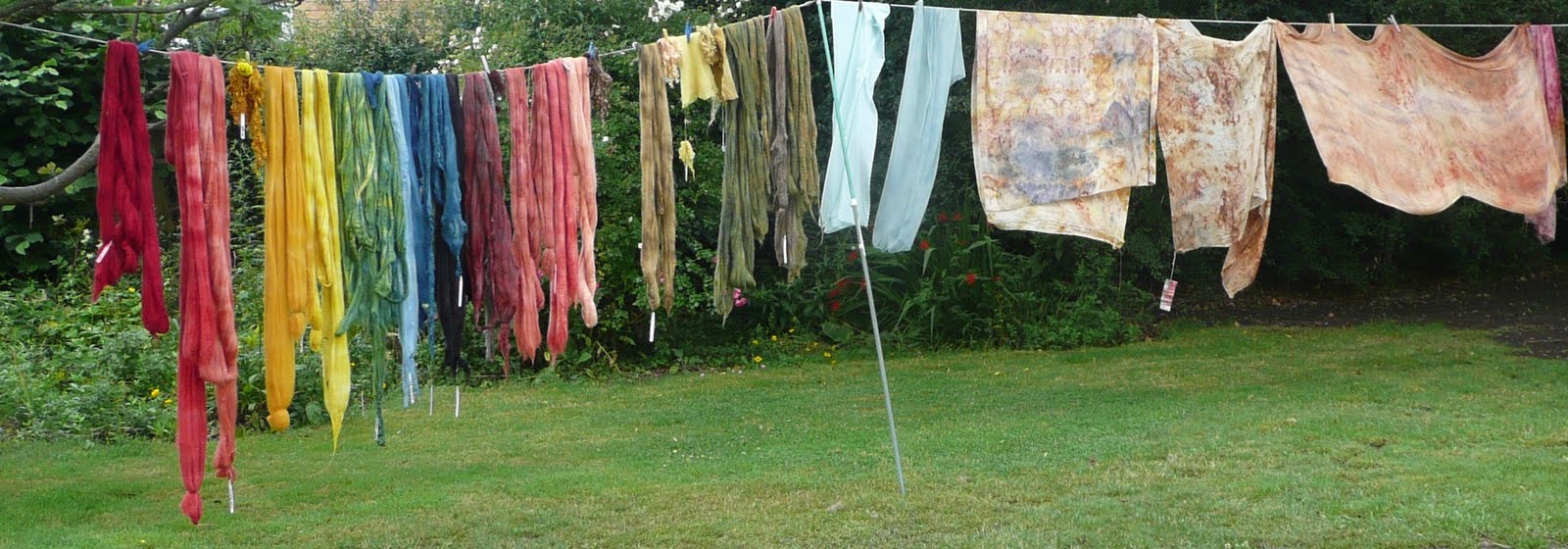
Last night DH said with a huge sigh of relief.  " Good! We can have a lie in tomorrow" This is because over the last few days we have had a textile group from Iceland visiting the dye garden and having a two hour workshop in the summer house and then two days later the BBC came to film the dye garden and what the director insisted on calling the " Dye Lady" for a Children's science programme called Nina and the Neurones.   Hence DH's  sigh of relief as it is he who rushes around mowing the lawn and setting up tables as well as removing dog particularly  from the filming day  (Because of  unwanted woofing)  while I work hard but get all the glory.  I was too  busy to take many photos  but I have put one up of the washing line. Everything on this line was dyed using either plants in the garden or if not quite that by plant material that I also grow. (Except I realised belatedly the red on the extreme left had some cochineal in).   This was in response to the BBC wanting a rainbow of colours on the line and was filmed a lot so it was worth the work. The yellows are Rhubarb root,Rheum spp, Gensita tinctoria and Tansy Tanacetum vulgare . The greens are Genista tinctoria and woad  Isatis tinctoria.  The blues are either woad Isatis tinctoria  or Persicaria tinctoria (which also dyed the blue silks) . The mucky greens are a patchy pale indigo overdyed in rhubarb root. The really dark almost black fibre is somewhat  surprisingly alkanet which I left on too high a heat so it boiled.( This is following extraction of the dye in alkanet by acetone) . The fabrics are silks dyed as solar dyed bundles .


Well I am  here typing, because  while DH is snoozing peacefully down stairs with dog,  I am upstairs in my office having -and this is sod's law- woken up early! So I thought I would share with you my experiments with hopi red dye plant. Amaranthus .whatsit I have been told by a friendly comment that this is A. cruentus x A. powellii,which is just as well as every time I ask Enys she looks vague!
Enys tried to grow this two years ago,  The seeds did not germinate so she threw the compost onto the greenhouse floor in disgust.  The following year she noticed she had lots of  little red plants growing on the green house floor. So she planted loads in my garden and in her own and in the green house.
When it came to dye with them I could find out very little.  None of my dye books -even the one Enys bought back from the USA on native North American Dye Plants contains any information beyond the fact that the Hopi Indians used it for dyeing corn in ceremonies.  A quick search on Google was not much help either resulting only in  that the Aztecs also used it in some ceremonies around blood.


So I picked a large handful of leaves and flowers chopped them up covered with water and added some pre-mordanted silk and teeswater fleece and heated in a slow cooker.   The teeswater went orange and the silk pinks as you can see but the pink washed out.  I added some  more fibres to the  dye bath and everything went a deep vivid pink.  About an hour of heating it all went orange and then another hour ) the colour had almost  gone and all I was  left with was a beige.
Aha! I  thought to my self,  this plant is a candidate for long slow dyeing , along with red cabbage and others where the dye seems to be destroyed by heat. (the only information I could gather was that the dyes are anthocynanins).

I had a friend here for the afternoon who often gets pressed into helping me and she suggested that we split the plant.  So we made up three solar  pots one of leaves, of stalks and one of flowers.
These are now sitting  in my sunny place waiting for some really hot sun to get going.  All the pots have now dyed the fibres a deep pink.

Tuesday, 6 July 2010

Recovering and new solar pot


I have had a peaceful couple of days-pottering around and amongst other things making a new solar pot. To do this I had to empty one in use and I chose my birch leave pot which has been on the go since May 5th and does not appear to be changing. So I removed the fibres-some teeswater and some prefelt and washed them and hung them on the line.
One of my first dye books- I think I have mentioned before- is Jill Goodwins A Dyer's Manual published by Batsford 0-7207-1327-7 . Jill, still, her daughter tells me spinning and dyeing in her 90's , has a fantastic list at the back of her book of all the plants she used and the colours with various mordants. The book itself is a little out of date particularly on the level of mordants but I still use Jill's method of dyeing with woad and I think it is still worth getting if only for the list at the back .
Very slowly I get round to trying some of the plants on her list. It was here I found that could get green with Mullien Verbascum thapsus and copper and also with horsetail (Equisetum spp).
I now make a copper mordant by submerging copper piping in water containing vinegar and leaving till the water goes blue with the copper acetate-Ipresume that this is what it is. I add copper piping and some solution to the pot so it is a very hit and miss affair, quantity wise .I picked 200g of equisetum from the hedgerow as I walked the dog, chopped it up , added some alum mordanted prefelt,and some unmordanted fleece, hot water , copper solution and my pot was done.
Left to right they are
Madder, Eucalyptus with iron , Golden rod with iron, new pot.

Sunday, 20 June 2010

Getting ready for Woolfest & More! Fibres! Solar Pots !


After two weeks of work experience Tara and I had amongst other things dyed 2 kilos of merino, handpainted 1 kilo and 20 silk caps.
New Solar pots are: Madder and Logwood, and Mullein with a copper mordant -made using copper piping and acetic acid. It is this which is dyeing the fibres turquoise at the moment!

Thursday, 3 June 2010

More On Solar Dyeing

From Left to Right the pots are birch leaves with added alum , rusty nails and copper piping

I have added more pots to my array. This is partly because my dye garden is open to visitors this month and it is something else for them to look at, partly because I am demonstrating and exhibiting at The Natural Dye at Trefriw Woollen Mill Conwy on Saturday June 5th. This is a day of dyeing with indigo and coreposis by me , demonstrating of spinning and felting, talks on dye plants , and solar dyeing demonstration. This leads me onto my pots. When my friend Anne was here (who is demonstrating the spinning) I told her about birch leaves and what a good dye it was. Off we went withthe dogs, and picked birch leaves. We half filled her 4 litre pot with birch leaves topped up with hot water, and then decided to try and add rusty nails as a mordant. DH joyfully pulled rusty nails out of planks from our newly demolished shed, we added them to the birch leaf pot and the water in the pot went black almost immediately, indicating that the leaves were high in tannin and the the iron had reacted with tannin to give grey to black. To the next pot we added a piece of copper piping and a tablespoon of the copper mordant I had made by putting copper piping into acidulated water (made by adding vinegar to water). This used up all the birch leaves we had collected but by this time we felt the pots would clearly illustrate colour modification by the different mordants so when DH next took the dogs off to the woods he picked some more and this time I added alum only to the pot. All of the solar pots had some unmordanted fine prefelt added which I had wetted out and some unmordanted mohair. As sod's law ( what ever can go wrong will go wrong) would have it we had no sun for a few days so yesterday was the first day the alum pot really got going and this morning is quite yellow.
This pot was started on May 5th. On the bottom layer is annatto seeds which I had soaked in vodka for 5 days to extract the dye. I added about 200ml or so of water and onto this I pushed down about a metre of pre-mordanted cotton muslin ( mordanted in 5% alum acetate) and added a tablespoon of a logwood dye bath as well as some logwood chips. This experiment was inspired by the new yahoo group I belong to, sustainabledyepractice, where we are investigating dyes month by month. The first one in May was Annatto and the second starting in June is Brazilwood. So yesterday I stuffed down some more premordanted muslin and added some brazilwood chips to the top and little water. It will be fun to see what has happened by the end of the summer!

A few people have asked me how to make solar pots. The most usual way I do it is to start with a glass jar, put in a generous handful of dye stuff if dried and about half the jar if fresh, add premordanted fibres, top up with warm water and leave in a sunny place. You can add unmordanted fibres and put in some mordant solution which is mostly what my friend Anne does. I leave my pots all summer befor emptying them out and seeing what has happened.

Saturday, 29 May 2010

Solar Dyeing

Chopped dried goldenrod from summer 2009
Eucalyptus leaves and madder with a view of annatto seeds on the right hand side.
My sunny place

Annatto seeds and logwood and cotton
An article on solar dyeing that I have written has just been published in the Weavers Spinners and Dyers Journal so this spurred me on to do some solar pots this year especially as we have been , until today , having quite a lot of hot sun.

Friday, 20 June 2008

Results of solar dyeing and good news about the dog.

This is a classic case of not following my own advice! I emptied this jar where the contents had been solar dyeing the other day about a month after I started it when really solar dyeing is better being left for as long a possible.
All the fibres and fabrics were premordanted. Silk caps overnight in a cold mordant of 35% alum (pottassium aluminium sulphate), the wool fibres in 8% alum, and 7% cream of tartar, the cellulose - a cotton gimp yarn I brought at Wonderwool from DT Crafts with 5% aluminium acetate. The cotton yarn was mordanted in the standard method of heating the fibres up over and hour simmer for an hour and allow to cool. The wool I heat slowly overnight. By the morning the bath is steaming but not boiling and I switch it off. I mention all this about mordanting as there has been a lot of discussion on mordanting on both Natural Dyes Online and the Online Guild of Weavers Spinner and Dyers. The latter have been running a fascinating and most interesting workshop in dyeing vegetable fibres with both natural and synthetic dyes. I would have really enjoyed doing it and in many ways I wish had but I also becoming increasingly fascinated by solar dyeing which fits alongside fermentation dyeing. and as we all know you can't assume the sun will be around-you have to seize the moment! I am also becoming increasingly convinced ( but don't have scientific evidence to back it up), that the raise over the hour, simmer for an hour allow to cool etc is the minimum and that long slow mordanting over periods of time and lower temperature result in better colours. I really need to set up a series of experiments to test this out-it would be a good one to do.

The dyes used were red cabbage, dyers camomile, coreopis tinctoria and some of my own madder. Everything was wet when I photographed it and the cotton has dried to a much paler soft colours very subtle!

ps Anyone interested in the case of my golden retriever might like to know that the Vet was extemely pleased with him on his last visit. His treatment has stabilised his condition and although he has lost a bit of weight he is enjoying life very much especially cooling his tummy in muddy puddles and having three meals a day. Formerly a G.O.D ( grumpy old dog) he is now a C.O.D ( cheerful old dog) and yesterday had two dog chews his and the one he snitched from the springer spaniel.