Saturday, 10 November 2007

Loostrife and lighfastness tests.


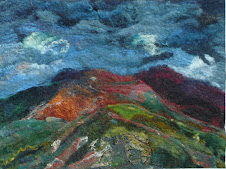
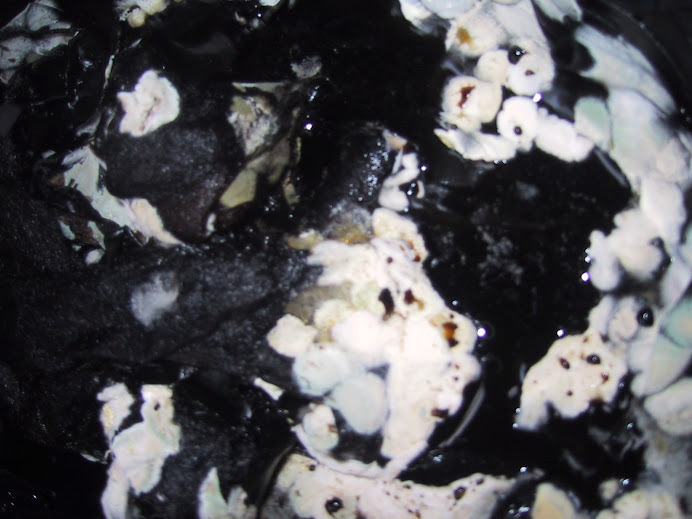
Still not managed to cut down my purple loostrife ! Thank you Bettina for your reassuring comment on this. I was teaching this week and taking my pictures into be framed and also some to a new gallery so I tell myself I have a good excuse. The frustrating thing is I am dying to try it, the more so because the fastness test I did on the purple loostrife and the eucalyptus leaves both with iron added have come out very well. Be prepared before you look a the pictrue and be disappointed. ! These are not the bright vibrant colours one hopes for. The pl flower heads gave a greyish green really a fantastic colour for landscapes ( one always wants a few sludgy colours) the other is my wonderful inky black from the eucalyptus leaves. You can tell how useful this is by the fact that as a out of 100g there is only about 20g left as it keeps being used The fibres on the right hand side are one dip of indigo as a control. The top thirds of the fibres weere covered and I stuck the whole lot to the pane of a south west facing window- for what was meant to be a month but was actually two. There is no loss of colour hooray hooray! means I can use the black in my landscape and the sludgy colour too. I was hoping to get more black with the purple loostrife whole plants and iron.

Thursday, 8 November 2007

purple loostrife and madder

It has been a frantically busy day but as far as the blog is concerned the so important event is that I still have not managed to cut my purple loostrife. By the time I cut it down the whole energy of the plant may have gone into producing seeds and the dye will have been lost. In the meantime of course both the woad and the japanese polygonum need to be cut too before any frost. However although it is cold and windy here it is not frosty so they may last a little bit longer.

I have had an email about madder. Quite unrelated to the blog she say she cannot get more than terracotta with a madder extract and has been advised to add calcium tablets - I think chewable calcium tablets and bring the pH down to 4 or 5. This seesm very low to me but I think it is worth a try just to see what happens. I wish I had 48 hours for every day to do all the experimenting I want to do because now I want to try this.

Wednesday, 7 November 2007

More on Madder

I have had an email asking me what the pH of the madder bath,which gave the red,was. I did not know but belatedly realised that the spent bath was sitting outside my studio waiting to be used for brown, so I tested that and found the pH was about 6. I assume that the pH would not have changed much and I was quite surprised that the bath was so acid. Then it occurred to me that the bath had definitely fermented when I first dyed with it. It had bubbles on the surface and the sweetish smell of a fermented bath. I know from studying fermenting indigo vats that fermentation produces lactic acid so that the pH goes lower so I wonder whether the fermentation lowered the pH
Is the production of a red due to :
1.low pH,
2.Fermentation which releases the red dye and causes a lowered pH
3..Long soak giving the red with its lower solubility a chance to appear.
4..All three
It makes one realise how very very complex a dye madder is. I think I will try adding vinegar to reduce the pH for the next experiment without the long soak.

Monday, 5 November 2007

This week has turned out to be a very busy one. I have two students coming on Wednesday and again on Friday and I suddenly have the opportunity to go to a School art fair, where teachers meet artists with a view to having them as artist in residence. The bore about this is having to get crb checked. Which if anyone is reading from abroad means a police check to see if you have nay criminal record before you can work with children and which takes months. I have been very much in two minds about this as I only teach adults,but the organiser initially not more than politely enthusiastic lit up when I said I was a felter and natural dyer. If some paid work came out of it it would be very good! Especially in the dead months of January and February!
I really want to dye with purple loostrife. The past two years I have used a few flowers but when I read more about it in both Dominque Cardons book and also in Rita Buchanans I found that you wait till the flowers have stopped flowering before using the whole plants. However everything is happening at he moment and the purple Loostrife is looking more "seedy" with yellowing leaves everyday. A frost is forecast for tonight so I think I must cut it down tomorrow at the latest Tomorrow I also need to get some pictures to the framers for an exhibition in Theatr Clwyd in December. This is probably the only day this week I can go and they need at least three weeks for frames. And of course I need to tidy up my studio and get ready for students!

Probably if I just get on and do it it will all happen!

Madder update. having dyed 50g of yarn to a fantastic red I added 100g of merino tops hoping to get more red. Instead I got a standard madder orange. I can't believe that 300g of madder would only dye 50 g of fibres ( or perhaps I can!). I think I ought to think about chopping up the roots as the Redpaths recommend ( former owners of Renaissance Dyers) or try the ground madder again. As well of course as the long soak. Hmmm In the meantime really old and very used old madder chips are now being boiled for hours in a slow cooker to get the brown.. These chips have already been used as a cold bath over three months to give some fabulous terracottas and oranges so it will be interesting to find out what else is there. More fibres are in the bath I got the red from and being heated gently to about 80 degrees C

Saturday, 3 November 2007


I meant to write this blog yesterday, but there was a lot happening , and on top of it my dh went down with the mother of all man colds and leaving me with reproachful dogs.
I have spent about six years trying all sorts of different ways to get a good red with madder. as i could not get anyhting but a reddish orange. I assumed the problem was that I have very soft wate. So I added chalk, lime water, washing soda, altered temperatures, pH, talked to people , listened to loads of advice such as grinding the roots , fermenting madder for 8 days and got beautiful colours terracottas, rusts, deep orangy reds and after leaving a bath on high overnight instead of switching it off, wonderful coppery reds with brown tones BUT NO RED!
DH and I and dogs went off for a weeks holiday in September. Just before I went I noticed a bowl of soaking madder chips I had forgotten about. I put them into a bin with a lid. When I returned I covered with water, added some mordanted wool, put the heat on very low and forgot about it. About four hours later I checked the bath and found the wool was a deep red.
I thought that it was probably the very long soak had bought out the red in the madder chips as the red dye has a lowere solubility than th eother colours , but now I wonder also whether fermentation did not have a role to play. Especially as the bath Iused yesterday was fermenting. Anyway on the 14th October I put 300g of madder chips into soak. Yesterday I put the bath onto heat and about four hours later this yarn appeared! It is good to know I can replicate the results.
yeay! One triumphant dyer!

Thursday, 1 November 2007


This huge clump of madder has now been washed. The soil washed off easily with a hose with a spray attachment . The slightly spongy roots look orange. The centre of the root clumps have lots of very red looking roots. Now I am starting to dry some.
I have dried sone in a very cool fan oven for about six hours. More are on top of my boiler and some I will dry on the drying rack in my studio. I would like to think of a way of steamng them. I have read of a method where a clay oven is heated till red hot. Then the wood is removed. It is then packed with madder roots which are pressed and water is sprinkled on top. I read this in Dominique Cardons book and will have to look up the references. The idea is that the chemicals in the roots change and moe towards the red ones so you get more red dye.

This is Enys digging the madder roots ( not me)