Friday, 27 August 2010

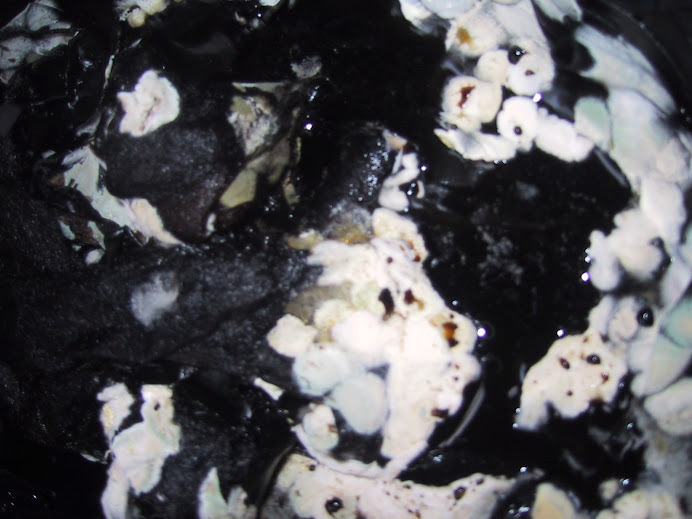
fermented indigo vat

Madder/Bran Fermentation vat ]
I started this on Tuesday night. as  I want it for my Dyeing the Blues Workshop on Saturday.
Recipe
The recipe calls for 9 litres of water but I filled up a small stainless steel pot- I think it might be 6litres
60g madder
30g bran
500ml of wood ash lye at pH 14. ( This is the last of my oak ash lye). I put this as even though  in proportion it might be too much but somehow I thought it would be okay. and as it turned out the final pH of the solution  was 9 verging on 10 which was fine and in fact the one important and critical measurement (along with the temperature)

25g of  finely ground indigo.stirred with hot water to a paste. The recipe called for 22g but I had a packet of 25 g so what the hell! It all went in. Would 3g really make a difference?

I boiled the madder  and bran , wood ash lye ,and water for twenty minutes,  allowed it to cool to 40 degrees C before adding the indigo paste, covered  and placed on the heating pad to keep warm. pH was 9. Incidentally a scientifically minded friend though the boiling was to get rid of the alizarin in madder. Certainly the froth  goes a fabulous purple or dark red colour.(I have had both colours). On this occasion it was more a dark red.
Wednesday am. The vat was 38 degrees, a  few bubbles on the surface. pH 9. Stirred . The vat is starting to smell that characteristic slightly sweet smell
Wednesday pm The vat was 42 degrees pH had dropped to 6.  I added 2 tablespoons of sodium carbonate ( washing soda). The pH drops because of the lactic acid produced by fermentation and at this stage you need to check the vat twice a day as pH can drop rapidly as you can see.  If the vat becomes acid the vat is described as going sour and the indigotin is lost.Vat smelling
Thursday am The vat was pH 7 I stirred added 2 tablespoons of washing soda, stirred and checked again. pH was now 9.
Thursday pm about 5.  The vat had dropped to about pH8 and was nicely warm at 42 degrees C.
I checked it again at 7 ish and it had dropped to Ph 6-7 so I stirred , and added 2 tablespoons of washing soda.  I used to make a solution and indeed used to use wood ash lye but this either means adding cold liquid  which cooled the vat down or heating it up and now I find adding washing soda works fine.  If in doubt as to howmuch to add  add a little like a teaspoon , stir and check the pH.
Friday am
Ph7-8  37 degrees C!-it seems to have been really cold overnight as the studio felt really cold this morning to the extent tha\t I discussed with DH lighting the wood burner to take off the chill.
I stirred, added 1 tablespoon of washing soda  to pH 9.
The vat had an indigo sheen this morning as well as a slight froth and the sweet fermented smell . I added some newly washed teeswater ( about 25g) down the side of the vat. At first  I  thought they went an olive green then perhaps a more yellowy colour.  Anyway I have left them in till this evening or possibly till tomorrow when the workshop starts.
Friday pm 
pH 7-8
 Stirred added 1 tablespoon of washing soda. Forgot to takethe temperature.

I have changed the title of my blog- this morning it seemed funny tonight feeling down it seemed offensive. .
I have lost a follower I  wonder why?

Madder bran vat day 3.5  sheen of indigo flower on surface 

Rather surprisingly the fibres have quite a green cast.  Was it the teeswater being a bit discoloured? I don't know.
very gradually the fibres turned a darker green but not really a blue.
Saturday 
Vat was 35 degrees C PH was 8, so Iadded a tablspoonof washing soda to bring it up to 9 and the little vat dyed all the day coping with 6 students putting two lots of stuff in each. A lot of the fibres still had this strange green cast and my other thought was that there was some yellow dye in the pan left after dyeing  otherwise I really cannot account for it.  In the evening I just  stirred it and left it.
 A tidy studio ready for 6 students!
 
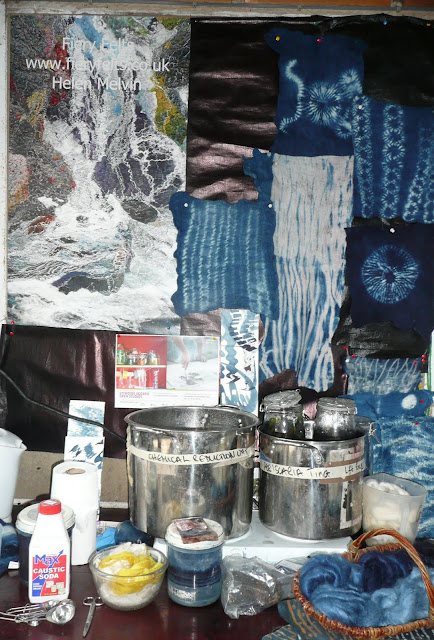
The Blue Table

 The results on the airer. The students  had 100 g of merino, half a silk cap, some silk chiffon,  and could pick from teeswater, silk cocoons, carrier rods.and some  yellow merino dyed with Gensita Tinctoria as as well as  dyed teeswater.  I think everyone had to work quite hard but they all dyed everything in their packs and some managed repeated dips for a darker blue

 On the Dyeing the Blues Day. We dyed with fresh woad leaves, fresh Persicaria Tinctoria for blue and in acidulated  water for turquoise-hanging at the further end of the airer.  We made up a Chemical reduction vat and the students were able to use a fermented vat.  The woad was  better than  I thought but the persicara-grown in Enys's greenhouse - was superb.  We did not have time to use the persicaria vat made form my home grown leaves so I am going to use  that this morning.
Sunday
Much to my surprise  this morning the fermented vat had bubbles on the surface and the pH was 9 Temperature was 36 C.

Wednesday, 25 August 2010

Two New Pictures and Helfa Gelf Open Studio

Yesterday I picked up my other two new pictures from the framers ready for Helfa Gelf  Open Art studio event in September.  .  When I picked these two up I felt excited and  I am so pleased with them both.  The Slate  Fence  is probably my favourite but the Snowy Fields  done one afternoon in the kitchen (because it was too cold to work in my studio) while looking at the  snow covered hills  is probably the nearest I get to painting at location.  It is has a slightly different frame from the other dark brown and woody looking with a slight texture and is a very quiet picture.  Chanel (one half of the picture framing team -the other is Tim) and I  both feeling very tired fantasised about a little quiet minimalist  room  with a  cup of coffee a book and my picture. Not got time to write more  I have got 6 people coming for a Dyeing the Blues day on Saturday and my studio has to have a major tidy to fit them all in

Monday, 16 August 2010

Natural Dye GArden on TV

My  dye garden  along with Enys and me is featured on a programme  called  " A little Piece of Paradise" about gardens open in Wales for the National Garden  Open Scheme tonight 16th of August at 8pm ITV Wales.  Here is an article about this programme and about my garden in the Daily Post.

You might like to know that I have raised about £230.00 pounds for charity showing  about 80 people around my garden this summer . 

I started this garden for my own interest and pleasure  and I am still bemused that so many people find it intersting.but in fact we have had a huge  positive response form many people form all sorts of interests-gardening , artists, embroidery,  local WI and Chapel groups .

Thursday, 12 August 2010

Stand for my naturally dyed merino


Dyeing with plants from the garden and making a gorgeous range of colours is one thing packaging and displaying  well to sell is another and  one of the challenges  about having  a stand at a craft fair is making good use of the vertical space.   If you hang things from the tops of the stand they don't sell but if they are on something that stands up they do. My merinos and hand spun yarn  are particularly hard to display and although I have tried all sorts of ways I finally asked   John Stoker the partner  of the Mulberry Dyer to make  me two stands  one for my hand spun yarns (on the left)  and then one large one for my merinos which at Woolfest and Wonderwool occupied one side of the stall.  Then having got got used to hanging my merinos up I was frustrated as I could not take this large stand to many of the smaller events I  do.  For  example next week I am off to teach at Malvern Hills Summer School where I will have twelve students in a small classroom  (Incidentally there are a few places left I believe on the Felted Collars-where we will be using 15micron merino.) .  After a table for samples this  leaves me one table for the "shop".  So. a few months ago .........from the back of my studio I stumbled on a  rotating stand made  many years ago and found it useful  for hanging merino only a little small.   I tried it out when I taught the North Wales Embroidery Guild and the Fiesty Felters in Shrewsbury and found I seemed to be selling more merino despite a price increase. So I decided to ask Michael Williams   who made the stand to make another one only a bit bigger.   Efficiently he still had the design for the first  one although it must have been a few years ago and made me a new one  and  here it is  it arrived yesterday .

Friday, 6 August 2010

New PIctures

Here are two of my new pictures -just back from the framers.
Night Sea and Rocky Stream.
Naturally dyed fibres and fabrics and machine stitch

Wednesday, 28 July 2010

Visits to the dye garden, the BBC and Hopi Red Dye Plant

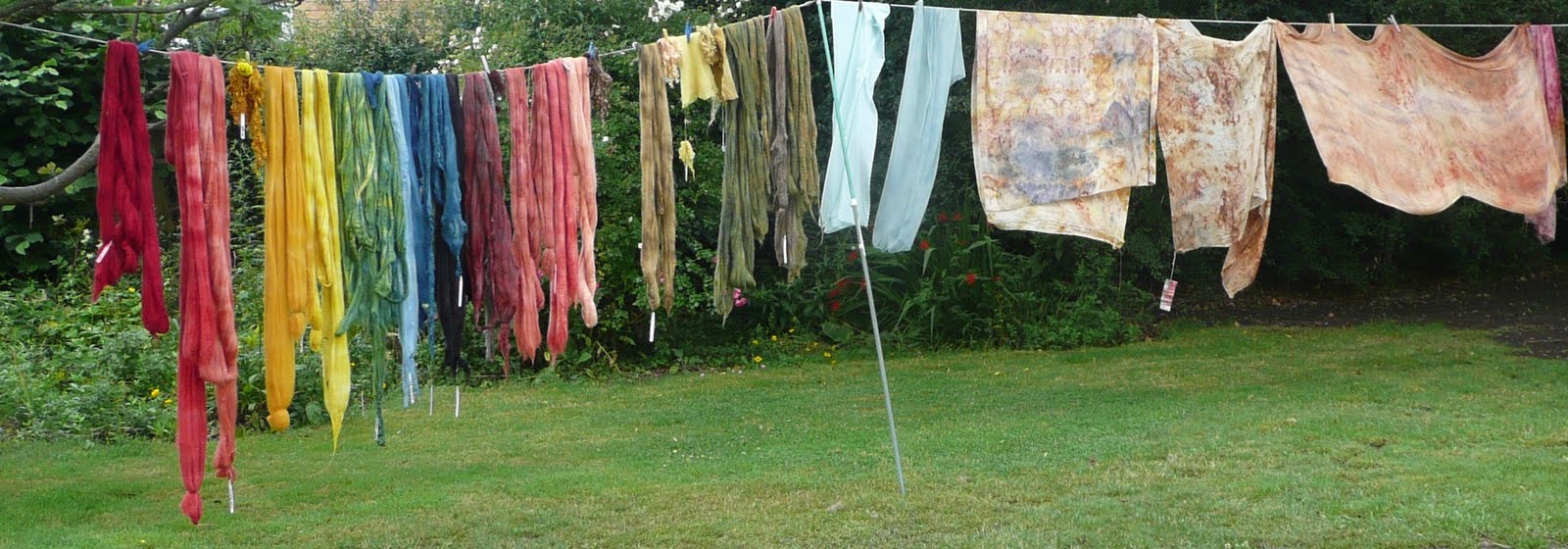
Last night DH said with a huge sigh of relief.  " Good! We can have a lie in tomorrow" This is because over the last few days we have had a textile group from Iceland visiting the dye garden and having a two hour workshop in the summer house and then two days later the BBC came to film the dye garden and what the director insisted on calling the " Dye Lady" for a Children's science programme called Nina and the Neurones.   Hence DH's  sigh of relief as it is he who rushes around mowing the lawn and setting up tables as well as removing dog particularly  from the filming day  (Because of  unwanted woofing)  while I work hard but get all the glory.  I was too  busy to take many photos  but I have put one up of the washing line. Everything on this line was dyed using either plants in the garden or if not quite that by plant material that I also grow. (Except I realised belatedly the red on the extreme left had some cochineal in).   This was in response to the BBC wanting a rainbow of colours on the line and was filmed a lot so it was worth the work. The yellows are Rhubarb root,Rheum spp, Gensita tinctoria and Tansy Tanacetum vulgare . The greens are Genista tinctoria and woad  Isatis tinctoria.  The blues are either woad Isatis tinctoria  or Persicaria tinctoria (which also dyed the blue silks) . The mucky greens are a patchy pale indigo overdyed in rhubarb root. The really dark almost black fibre is somewhat  surprisingly alkanet which I left on too high a heat so it boiled.( This is following extraction of the dye in alkanet by acetone) . The fabrics are silks dyed as solar dyed bundles .


Well I am  here typing, because  while DH is snoozing peacefully down stairs with dog,  I am upstairs in my office having -and this is sod's law- woken up early! So I thought I would share with you my experiments with hopi red dye plant. Amaranthus .whatsit I have been told by a friendly comment that this is A. cruentus x A. powellii,which is just as well as every time I ask Enys she looks vague!
Enys tried to grow this two years ago,  The seeds did not germinate so she threw the compost onto the greenhouse floor in disgust.  The following year she noticed she had lots of  little red plants growing on the green house floor. So she planted loads in my garden and in her own and in the green house.
When it came to dye with them I could find out very little.  None of my dye books -even the one Enys bought back from the USA on native North American Dye Plants contains any information beyond the fact that the Hopi Indians used it for dyeing corn in ceremonies.  A quick search on Google was not much help either resulting only in  that the Aztecs also used it in some ceremonies around blood.


So I picked a large handful of leaves and flowers chopped them up covered with water and added some pre-mordanted silk and teeswater fleece and heated in a slow cooker.   The teeswater went orange and the silk pinks as you can see but the pink washed out.  I added some  more fibres to the  dye bath and everything went a deep vivid pink.  About an hour of heating it all went orange and then another hour ) the colour had almost  gone and all I was  left with was a beige.
Aha! I  thought to my self,  this plant is a candidate for long slow dyeing , along with red cabbage and others where the dye seems to be destroyed by heat. (the only information I could gather was that the dyes are anthocynanins).

I had a friend here for the afternoon who often gets pressed into helping me and she suggested that we split the plant.  So we made up three solar  pots one of leaves, of stalks and one of flowers.
These are now sitting  in my sunny place waiting for some really hot sun to get going.  All the pots have now dyed the fibres a deep pink.

Sunday, 18 July 2010

Browns

Not a colour I often get asked for but earlier on this week one of my regular customers emailed me to ask for 200g of  brown . I had some rhubarb root with iron but not much else so enjoying the challenge I set to soaking and mordanting.
 I decided to go for the boiled madder brown, cutch and logwood (chocolate brown)  and because I had  had a brown recently with eucalyptus leaves and iron  (when I was trying to get black) I decided to try that. (Why did I not do just cutch?I haven't an  idea just trying to be too clever by half I think plus the fact that cutch on wool is not a strong brown)
Natural dyes are perverse,  maddening and never do what you want .  The boiled madder refused to go brown -now how often have you seen in dye books "be careful not to raise the temperature of the bath too high as you  will get a brown"! Over dyed orange madder in indigo normally gives a wonderful warm brown but this time gave me a fabulous purple.  If I had been trying for purple I would have got brown. The eucalyptus which gave a wonderful warm brown with iron is giving a soft greens  browns and almost creams ,but here the difference must have been in the soaking time as previously it was soaked for  at least a week after boiling.  The cutch and logwood came out a wonderful dark grey.  I added some fustic extract why I don't know I think that morning my brain was a bit addled  and I suppose because until I rinsed it I  thought it was purple) and it went green so I added some madder extract and that is still in the pot waiting to be rinsed. All these" not browns but something else"  is partly because I  tend not to keep enough records-mea culpa- and also because I do just tend  to dye rather than dyeing for particular colours but  it would have been infuriating if I had not got such a fabulous grey and also the purple from madder and indigo which  is lovely. I can use all the colours and sell them so it is not a problem really but dyeing for specific colour is not my forte.
Here are some of them hanging on the line.
Above a very exhausted madder giving beige, Cutch/logwood/fustic. Eucalpyptus and iron  (also on right). Madder overdyed in indigo. Cutch/logwood first bath.   Next to it just out the bath so very wet is madder and iron.  A lovely dark red not really a brown. Hiding shyly under the  dark indigo-incidentally at least 8 dips- is a brown.Orange madder overdyed in indigo second attempt.
In more detail.
The over dyeing in indigo is patchy because I was using quite a small vat.  Now wouldn't you think I would  know better!
Now I will go and rinse the remainder out.  Also I shall be rinsing out to day some of the hand painted 15micron merino I dyed yesterday with extracts.  They are looking fabulous. I am teaching the way to felt with  this fabulous fibre  at Malvern Hills Summer School in August in one day workshop.