Show all posts
Welcome to some new followers of my blog Yvette, Willington Weaver( Hi Alison) Mollys and Martine.

I have been busy making new ink colours. The inks have been a bit quiet or rather the sales of them have been quiet but have suddenly started to pick up. Every time I ran a workshop someone would buy a set of 5 or 8 and people have been coming back for more and like ripples in the pool they have been getting to a wider audience. Two local artists , amongst others, have been using them; David Brightmore and Jan Gardner. It was David who started me off on the journey of actually making inks rather than concentrated dye baths, which I had been using and tells me that he has sold some of his pictures painted with my inks and he has also been back for more.
Last week Debbie Bamford went off to the original reenactors market at Coventry taking with her my medieval inks; a medieval black, yellow and red, the black and the red being new. She sold a few and says that there was a lot of interest, but it takes time for people to buy something new: it is seems so odd to hear my medieval inks described as something new as the very name makes them sound antique and you would expect re-enactors to leap on them with cries of joy, especially as Debbie sells quill pens, but apparently not, apart from a discerning few. In the meantime having a few days free between the end of one set of workshops and the next series in Jersey I decided to bite the bullet, gird my loins and face the challenge of blue. The reason for the girding of the loins part is that I thought the only way to make a good blue was by going via saxon blue. Saxon blue is in fact indigo sulphonate which is indigo dissolved in concentrated sulphuric acid. I was a bit concerned about using this as my memories of A level Chemistry were rather in a dim and distant past , but one of the people who came to my last workshop on mitten making is Pam who teaches Chemistry . She went through safety procedures with me so on Sunday I made some indigo sulphonate wearing goggles, face mask, vinyl gloves and old clothes., stirring finely ground natural indigo slowly and carefully into a measured lot of concentrated sulphuric acid. It had to be left for two days but today it was ready for use so I experimented with making it up into an ink and here is the result.
Last week Debbie Bamford went off to the original reenactors market at Coventry taking with her my medieval inks; a medieval black, yellow and red, the black and the red being new. She sold a few and says that there was a lot of interest, but it takes time for people to buy something new: it is seems so odd to hear my medieval inks described as something new as the very name makes them sound antique and you would expect re-enactors to leap on them with cries of joy, especially as Debbie sells quill pens, but apparently not, apart from a discerning few. In the meantime having a few days free between the end of one set of workshops and the next series in Jersey I decided to bite the bullet, gird my loins and face the challenge of blue. The reason for the girding of the loins part is that I thought the only way to make a good blue was by going via saxon blue. Saxon blue is in fact indigo sulphonate which is indigo dissolved in concentrated sulphuric acid. I was a bit concerned about using this as my memories of A level Chemistry were rather in a dim and distant past , but one of the people who came to my last workshop on mitten making is Pam who teaches Chemistry . She went through safety procedures with me so on Sunday I made some indigo sulphonate wearing goggles, face mask, vinyl gloves and old clothes., stirring finely ground natural indigo slowly and carefully into a measured lot of concentrated sulphuric acid. It had to be left for two days but today it was ready for use so I experimented with making it up into an ink and here is the result.


The first is a weak concentration and the second a higher concentration . The texture on the surface is the paper's (I think) which is a heavy weight rough textured paper 425not- i.e paper that has not been either hot or cold pressed to give a smooth surface. However I was a little concerned about the look of that ink so when I made up the full amount I made sure that the thickener was very well dissolved and smooth.

My next ink is a bronze. I have long been wanting a bronze. The recipe I have for bronze ,which I found in Dominique Cardon's book Natural Dyes, and which apparently was designed for the Marquis de Pompadour, the husband of the courtesan Madame de Pompadour mistress to Louis XVth. The recipe was for brazilwood and weld and I used a variation of it for the fibres for the felt bronze bell which I made with the children of Bodfari school. I was really pleased with the colour . I have been trying to replicate this in ink but it had not worked but after a lot of experimenting using a combination of three dyes I made a bronze I liked. I am not going to say exactly what the dyes are -a girl's got to have some secrets- and after all I do sell them, but above you can see the result . The painting in the blue and bronze is a sheet of watercolour paper destined to make five covers for my dye books which continue to sell steadily. One of the things I really liked is the interaction the blue and the bronze, sometimes it went a very gorgeous green , but a tiny bit of blue on the brush made the bronze go into different bronze colours. Quite yummy in fact!

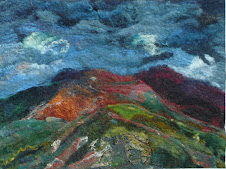
I noticed that India Flint describes herself as a mark maker which description I like very much and wished I had thought of-sigh- It occurred to me that what I do when I make my dye book covers is not painting but making marks and above is another also in bronze and blue but using different brushes and marks. Finally I have put in one of my pictures- a design for felt which never happened as when I tried to translate it into felt it did not work, but I like the painting.