Thursday, 25 March 2010

A Working Studio,Organised Chaos or What the BBC saw!


Dot Lumb in her blog Fibre 2 Fabric mentioned the state of her studio saying that the place that had been immaculate two years ago was now almost too full to move in. It set me thinking about my studio. One fellow artist just says "Oh my God" whenever he sees it Early on in the week I taught 7 people Felt Beyond the Boundaries-incidentally one of favourite workshops- in a beautiful pottery studio ( Ceri Pottery) high in the hills near Newtown in Powys. Her large studio with two pottery wheels and lots of working space was immaculate and really put mine to shame. My worse enemy could not describe mine as immaculate and here it is in all its organised chaos glory with photos from the doors at either end. This is what the BBC saw when they came interested in running a children programme .
I thought it would be fascinating to have a show of working places. What does your studio look like?
Mine I realise is going to have a face lift before the Open Studio event later this year Helfa Gelf. sigh.When?I don't know and where will everything go while I wash down the walls and paint? I know it needs to be done and I will feel better for it but ..............................arrgh!

Saturday, 20 March 2010

Spring has come to the Dye Garden


Spring has Come!

As well as crocuses miniature daffs, catkins and the fabulous delicate dwarf irises spring means other things to the dyer! Yesterday for example I was able to work in the studio without having to light my wood burner, I could hang my fibres to dry on the line and finally something , which although it has nothing to do with dyeing , excited DH and I somewhat -we have frog/toad spawn (I not sure which) in our little pond. Last night we heard the gently croaking call of an amphibian-. The little pond had been around for four or five years and over the last two we have spotted an increasing number of frogs and toad although they are very shy. Last summer when we had been away for a week they had obviously colonised the pond and I saw a frog squatting on a lily pad but sadly the pond which is in our battered flagged patio (all the flags are uneven) is probably too near the house for them to lounge around at their ease. So we are delighted to see our spawn .
Other nice things happened. Last year my studio was open for an Open Art Studio event Helfa Gelf ( meaning Treasure Hunt) .The organisers ran a raffle, the winner having £500 to spend on art. The winner has chosen four artists who she wants to look at in more detail and she chose me as one. She came out yesterday and to have a look although she wanted either something like Tree against a Red Hill ( which you can see on my website) or a Waterfall both of which I have sold.

Then the BBC rang up to see if I was interested in a (very) cameo appearance dyeing with children on an children's programme.

On the dyeing front I am dyeing like a women possessed as I have so many workshops coming up for which I always provide all the materials in natural dyes. Increasingly in recent years I have been booked up by groups and this year I am really busy . On Monday for example I am teaching a small group of artists in mid Wales a workshop of mine called Felt beyond the Boundaries. A week today one I am running one called Felt Collars, here for the first time I will be teaching the students to felt a fine felt collar with lacey edges using the incredibly fine ultra fine 15 micron merino. Dyeing this without felting that been a challenge! Up and coming is another Felt beyond the Boundary for a group on the LLeyn Peninsular and Felt and Fabric Tote bags and Asymmetrical Bags in Gloucester both in May. In between is Wonderwool so the dye pots are constantly on the go and you can see why being able to hang stuff upon the line outside is such a relief.

The dark pink fibres on the line are cochineal extracted from the whole bugs similar to the recipe described by Leena on her fantastic blog on cochineal which you can find here. It saves the grinding but I am not sure that it gives such a bright pinky red colour as does grinding the cochineal bugs and soaking with cream of tartar. This is the method I have used in the past and comes from Trudy Von Stralen's book Indigo Madder and Marigold. I plan to grind some today but it will be Tuesday before I can dye with it

As revenge for me saying Spring has come the changeable British weather has now clamped down with a hill mist and heavy rain. Oh well at least the frogs and toads will be happy as the pond fills up.

Wednesday, 3 March 2010

Weld (Reseda Luteola) -yes actually some dyeing!

I was checking back on some old posts and was amazed how much I wrote in 2007 and feel somewhat abashed at the contrast with now. I am dyeing most of the time and making inks ( which are selling very well) but don't think to blog about what has become routine(ish).
Kev, a fellow member of the members of the Online guild of Weavers Spinners and Dyers, sent me some of his own weld extract which he had made himself, I am not sure when but probably about 18 months ago. Here is his website with the information on how to do it. A couple of weeks getting ready for a couple of big workshops I needed some greens in a bit of hurry and realised I had still got Kev's extract. You know what it is like when someone sends you something a bit special you put it on one side to use for something special. Then, months later, when you are tidying up you find it again. So this time I thought I will use it instead of waiting for this mythical special event!

He had sent me a small pot of the weld extract- but did I weigh it -did I heck :( . I tipped the small hard dull yellowy brown pieces ( probably about 20g or so) into a small jug and poured over hot water. If I had checked Kev's website I would have seen he said to dissolve it in ammonia but dissolving it in hot water worked well although it took half an hour or so. I poured the resulting liquid into a slow cooker, topped up with water and added 200g of merino tops mordanted in 8%alum 7%cream of tartar. See here for more about mordanting .
The fibres came out a bright yellow but I added a drop of ammonia-if I do not when the wool used in felting the fibres go a bright floresecent yellow with the pH of the soap.
rinsed the fibres, partially dried them and then immersed into an indigo vat . Look at the absolutely gorgeous green in the top right of the top photo.
Altogether the weld extract dyed 600g of merino tops in strong to pale yellow and overdyed with indigo I got some yummy greens .
Thank you Kev - this was infinitely better than attacking my pile of dried weld which needs to be chopped up outside as it make such a mess.

Tuesday, 2 February 2010

More on Art Work to Yarn

I spent a weekend with my friend Anne. It was her birthday and she is possibly the only person I know who, on receiving three carded batts as a birthday present, utters a cry of delight. She spun them all that evening and we both felt so inspired that the following day we decided to card and spin some more.
For starters we choose as design source one of Anne's husband's pictures. I adore his work and DH and I have no less than 5 of his but this one is one they kept, and so we picked out as many colours as we could to match from Anne's fibre stash. We carded them on her carder which had fine teeth which was unlike my coarse tooth one on which one could add lots of texture so the rolags were different, fine and delicate as you can see. It took all morning to card four rolags-it is a time consuming process- and then we both spun them. I had my lendrum with the jumbo flyer and the band set on the biggest whorl, Anne wwas using her versatile Louet also on the biggest whorl. Possibly because the rolags were so fine much to my surprise I found myself spinning a relatively fine yarn while Anne spun a thicker one.
Here is mine after a dunk in hot soapy water . I love it. And I enjoyed every step of the way!
Welcome to new followers.

Sunday, 24 January 2010

Art Work to Yarn


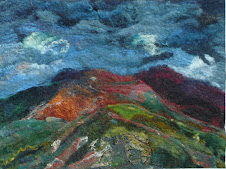
I am only doing routine sort of dyeing at the moment , getting purples and greens for some up and coming workshops in February but nothing of note. However I suddenly yearned to create colour so while renewing bonds with a textile group Chameleons I indulged in translating a photo by Linda Jones- a member of the group- into a painting. Linda takes fabulous photos. A textile artist herself she has an eye for pictures that will translate into textiles. This one that I used is a photo of water moving into a mossy water weedy surface so is full of whites dark greens.turquoise wit the odd flash of pale terracotta. unfortunately my photo of her photo not very good nor for that matter of fact is that of my painting which is a shame as neither show clearly the colour or texture. I had fun painting with my natural dye inks and then putting pastel over the surface although I had no particular plan in mind which is the way I like to work however the following evening , on my own and deciding to watch a film I decided to card some fibres for spinning.. Three or four trips ( because I kept going back for more colour or more texture) to the studio resulted in dark green, blues, purple merino, white and dyed silks: laps, throwsters waste and textured wools. I used a wide coarse carder, and put the fibres though once and spent an happy evening making three large rolags. Each one represented an area of the picture.
The following day I started to spin a singles yarn on the top whorl of the jumbo flyer of my Lendrum pulling strips off the rolag and spinning from top to bottom of my picture.
I gave the hank a very hot soapy wash at the end and was pleased that there was little colour loss and gave the fibres a tug to straighten the fibres out.
I really enjoyed the whole process and I love my yarn.

Saturday, 16 January 2010

Waterfall 3 framed


I got the picture back from the framers done in double quick time-just 6 days. Tim and Chanel of of the Cathedral Framers St Asaph Denbighshire ( in case you want some work done-strongly recommended by me) normally like 3 weeks so I was really grateful. It is hard even to believe that we were in such desperate straits, snowbound and with freezing weather as now we have had a thaw and there is only a little snow on the hills and we are back to a green world again.
I am really really pleased with it.
Just to compare here is Waterfall 2 done in 2007, Waterfall 1 my first piece done in 1997 I have no good photos of unfortunately

Thursday, 7 January 2010

Indigo:natural versus synthetic

Leena has just pointed me to a site that aims to explain the difference between synthetic and natural indigotin( commonly called indigo). This is an translation of a Japanese paper and in summary say that while the synthetically derived Ai ( Japanese Indigo) is chemically the same as natural ai the bonds between the natural are shorter. Someone adding acomment says that the natural ai aggregates. This has an impact on the way it behaves while bonding to textiles and means that natural ai bonds better , is less likely to be washed off and less likely I think to crock. Interesting piece of research!